

Buda Castle Tunnels & Underground Labyrinth: Visitor Guide
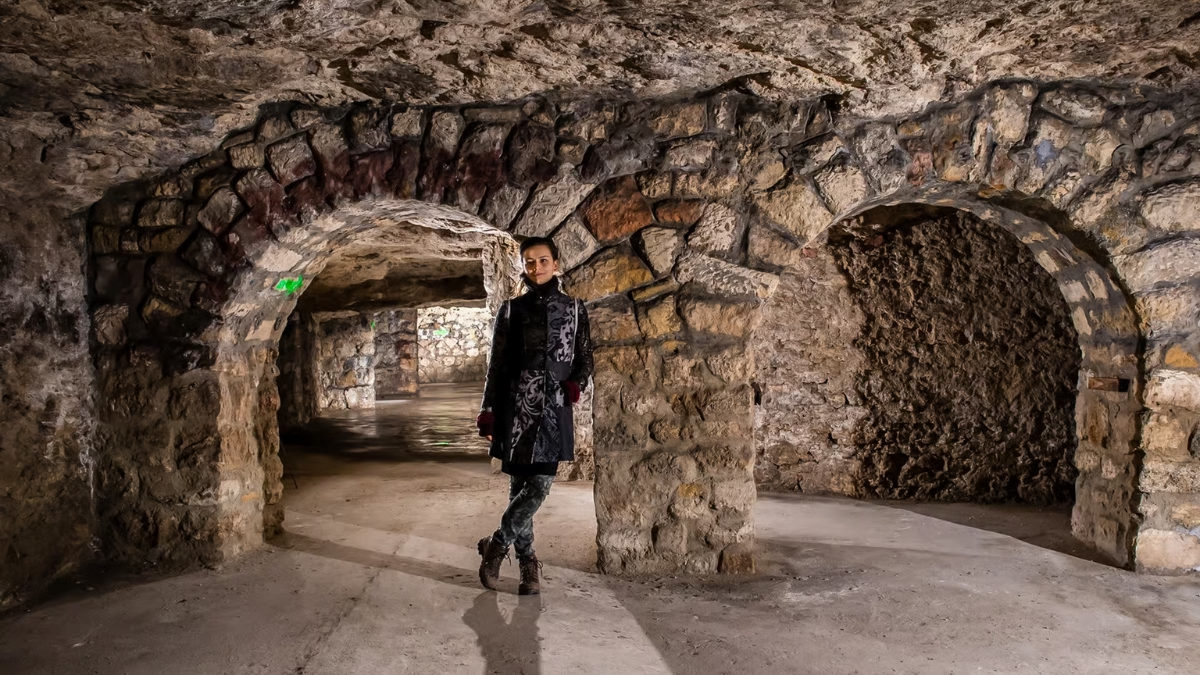
Castle Hill sits on a limestone ridge riddled with natural caves that people have connected, carved, and enlarged into cellars, shelters, and passages over roughly 800 years. There are several distinct ways to experience this underground world today — a guided cave tour through the caverns and cellars, a separate Labyrinth exhibition, and the Hospital in the Rock, a real WWII-and-Cold-War shelter turned museum — and they are not interchangeable. Expect cool, dim conditions and uneven footing underground, so confirm access and suitability before you book.
Buda Castle isn’t only what you see on the surface. Beneath the courtyards, terraces, and museum halls of Castle Hill runs a genuine network of natural caves, formed in the soft limestone bedrock, that people have been shaping for their own purposes since at least the medieval period. Wine merchants extended them into storage cellars, wartime planners turned sections into shelters and even a working hospital, and Cold War authorities converted part of the system into a bunker. What began as geology became, over centuries, a layered piece of the hill’s history that most surface visitors never see.
This guide explains what’s actually down there, how the different underground attractions on Castle Hill differ from one another, what it feels like to visit, who should think twice, and how to plan a visit — including where things stand with the Labyrinth, whose operators and access have shifted more than once over the years.
What’s Actually Down There
The core of the system is natural: limestone caves and cavities that formed in Castle Hill’s bedrock long before anyone settled it. Over centuries, residents connected, deepened, and lined sections of that natural network into wine cellars, storerooms, and passages, so what you walk through today is a mix of raw rock and worked, reinforced tunnel.
Castle Hill’s underground character comes down to geology first. The hill is riddled with karstic caves formed by thermal water working through the limestone over thousands of years — the same kind of process behind Budapest’s famous thermal springs, just a few streets away. Once people settled the hill, they didn’t just use the caves as they found them; they linked separate cavities together, dug new connecting passages, and cut cellar space directly into the rock, expanding what had started as a natural formation into a working underground district that shadows the streets above it.
Because the network grew piecemeal over roughly eight centuries, it isn’t uniform. Some stretches are bare limestone chambers, occasionally showing mineral formations on the walls and ceiling; others are worked passages with brick or stone reinforcement where cellars were cut deeper or shored up. It is not a single continuous “tunnel” so much as a patchwork of connected caves and cellars under different parts of the hill, historically used by different buildings and, more recently, divided among different visitor attractions.
Three Different Underground Attractions — Don’t Mix Them Up
“Buda Castle’s underground” is not one attraction. The guided cave tour, the separate Labyrinth exhibition, and the Hospital in the Rock museum each occupy different sections of the hill, have different entrances, and are booked separately — visiting one does not give you access to the others.
This is the single most useful thing to understand before you plan an underground visit, because the three are easy to confuse from a distance and genuinely different once you’re there.
The cave and cellar walking tour enters through a doorway on Dárda utca, on the western side of Castle Hill, and is guide-led rather than self-guided. It covers a route of roughly 1.5 km through natural caverns and man-made cellar sections on paved, lit paths, with a live guide explaining the history as you go — wine storage, wartime shelter use, and the local legend that ties the caves to Vlad III (the historical inspiration for Dracula). Our cave tour review covers the route, timing, and booking details in full.
The Labyrinth (Budavári Labirintus), entered from Úri utca on the opposite side of the hill, is a separate exhibition-style attraction built around a different section of the same underground network. Over the years it has run under different names, themes, and operators — at times leaning into a “historical labyrinth” format with statues and staged scenes, at other times marketed around its Dracula-legend connection — and it has gone through periods of closure and reopening as management changed. Because of that history, treat any specific claim about the Labyrinth’s current hours, ticketing, or even whether it is open at all with some caution, and confirm its current status directly before building a visit around it.
The Hospital in the Rock (Sziklakórház), entered on Lovas út on the northern side of the hill, is a different kind of underground attraction altogether: a real hospital carved into the natural caves during the buildup to WWII, used to treat casualties during the 1944–45 siege of Budapest and again during the 1956 revolution, and later converted into a secret nuclear bunker during the Cold War. Today it operates as a museum, visited only on guided tours, with preserved medical equipment, gas-tight blast doors, decontamination chambers, and wax figures staged in period scenes. It’s a more sobering, history-focused visit than the caves or the Labyrinth, and it’s covered by a dedicated WWII siege and bomb shelter tour.
In short: the cave tour is about the geology and the old cellars, the Labyrinth is an exhibition experience layered onto part of the same rock, and the Hospital in the Rock is an actual historical site turned museum. Booking one does not include the others, and their entrances are on three different streets around the hill.
A Brief History of What Happened Down Here
The caves have been used, in rough order, for medieval and early-modern cellar storage, as air-raid shelters and a working military hospital during the WWII siege of Budapest, and as a Cold War civil-defense and nuclear bunker space — a layered history that today’s different attractions each draw on in their own way.
The earliest documented uses of the underground network center on storage. The naturally cool, stable temperature made the caves and cellars ideal for keeping wine and provisions, and residents of the hill expanded the network for exactly that purpose over centuries, well before anyone thought of it as a visitor attraction. By the time Budapest faced the devastating 1944–45 siege at the end of WWII, the same qualities — depth, stability, insulation from the fighting above — made the caves valuable in a very different way. Sections were converted into air-raid shelters for civilians, and one part of the network was fitted out as an emergency operating hospital, treating wounded soldiers and civilians through the worst of the siege under conditions that are hard to imagine walking through today. That hospital saw service again during the 1956 revolution before the Cold War gave it one more role: reinforced, sealed, and stocked as a nuclear-fallout shelter, ready in case the tensions of the era turned into something worse. It’s this specific stretch of tunnel that survives today as the Hospital in the Rock museum, while other parts of the same broader cave system were left as cellars or later reopened as the Labyrinth and cave-tour attractions.
What It’s Like Down There
Expect cool air year-round — commonly cited in the roughly 10–16°C (50–61°F) range depending on the section — along with dim lighting, echoing acoustics, and uneven or narrow stretches even where paths are paved. It’s a genuinely different environment from the sunny courtyards above, and worth dressing for.
Whichever underground attraction you choose, the physical experience has a lot in common. The temperature sits well below whatever it is outside, so a light layer is worth carrying even on a hot Budapest afternoon in July — the caves don’t warm up with the seasons the way the surface does. Lighting is deliberately kept low in most sections to preserve the atmosphere and the rock itself, which means your eyes need a minute to adjust and photos without a flash can be tricky. Ceilings and passages narrow in places, footing is uneven even on paved paths, and there’s no cell signal once you’re a level or two down. None of this is dangerous on a maintained, guided route, but it is a real sensory shift from the open terraces above — quieter, closer, and considerably darker.
Is It Right for You? Claustrophobia, Kids & Mobility
None of Castle Hill’s underground attractions are wheelchair- or stroller-accessible, and none are recommended for anyone uneasy in tight, dim, enclosed spaces. Operators typically discourage very young children, though older kids who aren’t bothered by the dark and close quarters tend to do fine, especially on the guided cave tour or the Hospital in the Rock.
Think honestly about claustrophobia before booking any of these. The passages narrow, the lighting is low, and you are, by definition, some distance underground with limited quick exits — fine for most visitors, but worth ruling out in advance if enclosed spaces are a known problem for you or someone in your group. Mobility is the other hard limit: steps, uneven surfaces, and narrow passages mean none of the underground attractions work for wheelchairs or strollers, and walking mobility should be reasonably good. For young children, operators generally set a minimum age (commonly around 3 on the guided cave tour) and, regardless of the posted rule, a dark, echoing cave is a lot for a toddler to handle calmly. Older children and teenagers usually find the caves or the Hospital in the Rock more interesting than intimidating, particularly with a guide narrating what they’re seeing. If accessibility is a concern for anyone in your party, see our accessibility guide for what does and doesn’t work across Castle Hill, above and below ground.
How to Visit: Tickets, Tours & Practical Tips
The cave and cellar tour is guided-only and bookable in advance; the Hospital in the Rock is also visited exclusively on guided tours; the Labyrinth’s access model has varied by operator and period, so confirm current hours and ticketing before you go. Budget 40 minutes to 1.5 hours underground depending on which attraction and option you choose.
For the caves and cellars under Dárda utca, book the guided cave tour in advance rather than turning up, since it’s guide-led with a fixed schedule rather than open walk-in access; it runs as either a roughly 40-minute short version or a longer 1.5-hour version depending on the date. For the Hospital in the Rock, the same logic applies — it’s guided-tour-only, and pre-booking secures your slot and language. For the Labyrinth on Úri utca, treat any hours or ticketing you find online as provisional: this is the attraction that has changed hands and formats most over the years, including periods when it wasn’t open to visitors at all, so check its current status directly before planning around it, and have a backup (the cave tour or the Hospital in the Rock) in mind if it turns out to be closed or altered when you arrive. None of the three underground experiences overlaps with the ticketed museums inside the palace itself — the Hungarian National Gallery, the Budapest History Museum, or Saint Stephen’s Hall — so budget for them separately; our ticket prices guide breaks down what everything on Castle Hill actually costs.
Frequently Asked Questions
Is the Buda Castle Labyrinth the same as the cave tour?
No. The guided cave and cellar tour enters from Dárda utca and is led by a guide through natural caves and old cellars. The Labyrinth is a separate exhibition-style attraction entered from Úri utca, on the other side of the hill, and has run under different operators and formats over time.
What is the Hospital in the Rock?
It’s a real hospital that was carved into Castle Hill’s caves before WWII, used to treat casualties during the 1944–45 siege of Budapest and again during the 1956 revolution, then converted into a Cold War nuclear bunker. It now operates as a guided-tour-only museum with preserved medical equipment and wax figures depicting the period.
Is the Labyrinth currently open?
Its access has changed several times over the years as operators and formats have shifted, including periods of closure. Confirm the current hours and ticketing directly before planning a visit specifically around the Labyrinth, and have the cave tour or Hospital in the Rock as a backup.
How cold is it underground at Buda Castle?
Expect cool air year-round, generally cited in the roughly 10–16°C (50–61°F) range depending on the section, noticeably cooler than the surface even in summer. A light layer is worth bringing regardless of the season above ground.
Are the caves and tunnels claustrophobic?
Passages narrow in places and lighting is kept deliberately low, so anyone uneasy in tight, enclosed spaces should think carefully before booking. It’s manageable for most visitors on a maintained, guided route, but it isn’t the right activity if claustrophobia is a real concern.
Can children visit the underground attractions?
Older children generally do fine, especially with a guide explaining what they’re seeing, but operators typically set a minimum age (often around 3) for the guided cave tour, and very young children can struggle with the dark, enclosed environment regardless of the posted rule. The Hospital in the Rock’s serious wartime subject matter is also worth considering for younger kids.
Are the underground attractions wheelchair accessible?
No. Steps, uneven surfaces, and narrow passages mean none of the caves, the Labyrinth, or the Hospital in the Rock are accessible by wheelchair or stroller. See our accessibility guide for alternatives on Castle Hill.
Do I need to book in advance?
Yes for the cave tour and the Hospital in the Rock, both of which run as guided tours on a fixed schedule rather than open walk-in entry. The Labyrinth’s booking model has varied with its operator, so check current arrangements before you go.
How long should I plan for an underground visit?
The guided cave tour runs about 40 minutes for the short version or roughly 1.5 hours for the longer one; the Hospital in the Rock tour typically runs a similar length. If you’re combining an underground visit with the free grounds above, our guide on how long to spend at Buda Castle can help you build a realistic schedule.
Does visiting the underground attractions include entry to the palace museums?
No. The caves, the Labyrinth, and the Hospital in the Rock are entirely separate from the ticketed museums inside the palace — the Hungarian National Gallery, the Budapest History Museum, and Saint Stephen’s Hall. Our overview of what’s inside Buda Castle covers those separately.
