

Buda Castle Grounds & Views: The Best Panoramas of Budapest
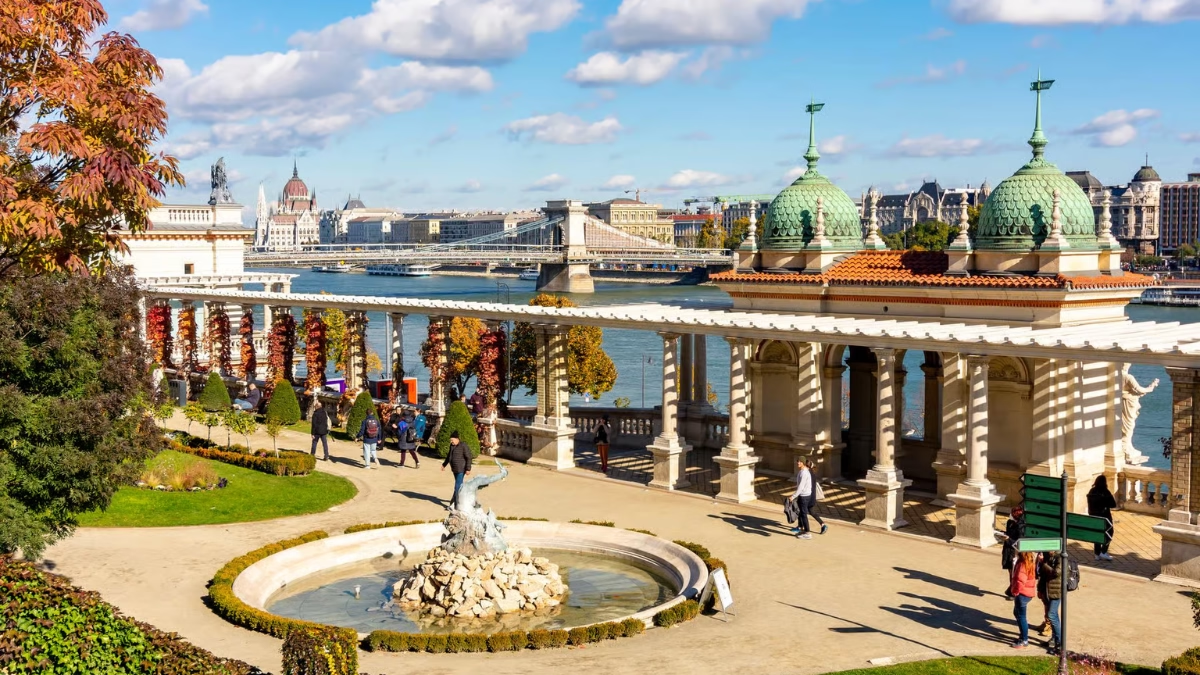
The Buda Castle grounds — the terraces, courtyards, gardens, and viewpoints — are free and open 24 hours a day, and they hold some of the best panoramic views in Budapest. The palace terraces above the Danube face Chain Bridge, Parliament, and the Pest skyline, while the Savoy Terrace, the Lion Courtyard, and the Castle Garden Bazaar each offer their own angle. No ticket, opening hours, or museum admission is required to see any of it.
Most visitors assume Buda Castle means the museums, and it’s easy to walk straight past the actual highlight: the grounds themselves. The terraces, courtyards, and gardens that wrap around the palace are public space, free to enter at any hour, and they deliver the view Budapest is famous for — the Danube curling below Castle Hill, Chain Bridge reaching across to Pest, and Parliament’s spires catching the light. You don’t need a ticket to any of the buildings to see it.
This guide covers exactly where to stand for the best panoramas, the free landmarks scattered across the grounds — the Matthias Fountain, the Turul statue, the Lion Courtyard — and the short walk to nearby Fisherman’s Bastion for the classic postcard view. It also covers the best light for photos and a simple route to see it all without doubling back.
The Grounds Are Free — and the Real Highlight
Buda Castle has no single “entry ticket” because the grounds are public space, not a ticketed attraction. Only the buildings inside — the Hungarian National Gallery, the Budapest History Museum, the National Széchényi Library, and Saint Stephen’s Hall — charge admission. Everyone can walk the terraces, courtyards, and gardens at no cost, any time of day or night.
This is worth stating plainly because it trips up a lot of first-time visitors: there is no gate, turnstile, or ticket booth for Buda Castle itself. The palace complex sits on public land, and the courtyards, terraces, gardens, and viewpoints that surround the museum buildings are open to anyone, around the clock, for free. You only pay when you step inside one of the ticketed institutions — the Hungarian National Gallery, the Budapest History Museum, the National Széchényi Library, or a guided tour of Saint Stephen’s Hall.
For sightseeing purposes, that’s good news, because the grounds are also where the best views are. You could skip every museum inside Buda Castle and still leave with the photos everyone associates with the place — the palace domes, the river, the bridges, the parliament building glowing gold at sunset — because all of it is visible from outdoor space that costs nothing to visit. If you want the full rundown of what’s ticketed versus what’s free, see our guide to what’s inside Buda Castle; this article is about everything outside those doors.
The Palace Terraces: The Main Event
The terraces along the Danube-facing side of the palace are the single best vantage point at Buda Castle, looking directly across the river to Chain Bridge, Parliament, and the Pest skyline. They run the length of the palace’s east side and are reachable on foot, by the funicular, or by bus, entirely free.
The terraces that line the eastern face of the palace, overlooking the Danube, are why people come up the hill in the first place. Standing at the railing, you get the full sweep: Chain Bridge (Széchenyi Lánchíd) crossing the water directly below, the dome and spires of the Hungarian Parliament Building further along the Pest bank, and the wider skyline of Pest stretching north and south. It’s the view that appears on nearly every Budapest postcard, and it’s free to stand and take it in for as long as you like.
The terraces are wide, paved, and lined with benches and low walls, making them comfortable for a slow walk rather than a quick photo stop. Because the palace sits well above river level, the sightline is unobstructed for most of the terrace’s length — you don’t need to fight for a gap in a railing the way you sometimes do at more cramped viewpoints. The funicular (Sikló) deposits you almost directly onto this terrace level if you ride up from Clark Ádám tér near Chain Bridge, which makes it a natural first stop on any visit.
Savoy Terrace
A smaller, slightly quieter terrace named for Prince Eugene of Savoy — whose equestrian statue stands here, facing the river — sits along the same palace front. The Savoy Terrace offers a similar river-facing panorama to the main terraces but with fewer people lingering, since many visitors walk straight past it toward the bigger open terrace or the funicular station. It’s a good spot to stop for a few unhurried minutes, especially if the main terrace is crowded with tour groups in the middle of the day.
The Lion Courtyard
The Lion Courtyard (Oroszlános udvar) is the grand entrance courtyard on the palace’s inner, western side, named for the pairs of stone lions guarding its gates. It’s more enclosed than the river terraces — the view here is of the palace’s own Baroque and Neo-Baroque facades rather than the Danube — but it’s an impressive space in its own right, and it’s the courtyard most visitors pass through on the way between the museums, the Matthias Fountain, and the rest of the grounds. The scale of the courtyard, flanked by the wings that house the National Gallery and the History Museum, gives a sense of just how large the rebuilt palace is.
Matthias Fountain
Tucked into one of the palace courtyards, the Matthias Fountain (Mátyás-kút) is a Neo-Baroque sculptural fountain depicting King Matthias Corvinus on a hunting expedition, along with figures from the legend of Ilonka, a huntress said to have fallen in love with the king without knowing his identity. It’s one of the most photographed details on the grounds — ornate, dark bronze against the pale stone of the courtyard walls — and it’s easy to find on the walk between the Lion Courtyard and the main terraces. Like everything else covered here, there’s no charge to see it and no set hours; it’s simply part of the outdoor grounds.
The Turul Statue
Near the main terrace, above a monumental staircase, stands the Turul — a giant bronze bird of prey from Hungarian mythology, wings spread, gripping a sword. It’s one of the largest bronze statues in Europe and one of the most recognizable landmarks on Castle Hill, both a striking photo subject on its own and a good orientation point: the staircase beneath it is one of the main routes between the terrace level and the lower approach from the river.
Ornamental Gardens and the Castle Garden Bazaar
Below the main palace terraces, on the slope facing the Danube, the Castle Garden Bazaar (Várkert Bazár) is a restored 19th-century garden and pavilion complex that connects the riverside embankment to the base of Castle Hill. It’s landscaped with terraced gardens, walkways, and a series of neoclassical pavilions and courtyards, and it functions as both a scenic approach to the castle and a pleasant stop in its own right, with occasional exhibitions and events inside the pavilions. The ornamental gardens closer to the palace itself — smaller planted areas and hedged walkways around the terraces — round out the grounds with some greenery between the stone courtyards. None of this requires a ticket to walk through, though specific exhibitions inside the Bazaar pavilions may charge separately.
Walking to Fisherman’s Bastion for the Classic Panorama
Fisherman’s Bastion sits a short, flat-to-gently-sloped walk north of the palace, past Matthias Church, and offers the other iconic Budapest panorama — looking north across the river with the fairy-tale white towers in the foreground. The lower terrace of the Bastion is free; the upper towers charge a small admission.
The palace grounds are only half the view. A walk of roughly ten to fifteen minutes north along Castle Hill, past Matthias Church, brings you to Fisherman’s Bastion, the neo-Romanesque terrace of white towers and arcades that offers the other classic Budapest panorama — a similar Danube-and-Parliament vista from a different angle, framed by the Bastion’s turrets. The lower terrace and surrounding streets are free to walk, while climbing into the upper towers for the elevated view requires a modest ticket. Most first-time visitors pair the two: the palace terraces for the wide river panorama, then the short stroll to the Bastion for the framed, fairy-tale version. For everything else along the way, our guide to nearby attractions covers the rest of Castle Hill.
Best Times and Light for Photography
Sunrise is the quietest and clearest time for photos, golden hour (the hour before sunset) gives the warmest light on the palace facades, and blue hour just after sunset — once the floodlights come on — produces the most dramatic shots of the illuminated palace and bridges. All are free to experience since the grounds never close.
Because the grounds are open around the clock, you’re not limited to daytime hours the way you are with the museums, and the light changes the character of the view dramatically depending on when you go.
Sunrise is the best-kept secret at Buda Castle. The terraces are nearly empty, the light is soft and clear over the Danube, and haze is less likely than later in the day. If you’re an early riser or dealing with jet lag, this is the single best window for unobstructed photos of the river view.
Golden hour, the hour or so before sunset, bathes the palace’s stone facades in warm light and is particularly good for photos that include the building itself alongside the river view — the terraces face roughly east, so the low sun from the west lights the palace walls beautifully while Pest starts to glow across the water.
Blue hour, the twenty or so minutes after the sun has set but before full darkness, is when Budapest earns its reputation as one of Europe’s best-lit cities at night. The castle’s floodlights, Chain Bridge’s illuminated cables, and Parliament’s exterior lighting all come on by this point, and the deep blue sky provides a far more dramatic backdrop than the black of full night. This is consistently the most-photographed window at Buda Castle, and it costs nothing to be there for it. Winter visitors get an advantage here: floodlights come on by mid-to-late afternoon when the sun sets early, so you don’t need to stay out especially late to catch it. For a broader seasonal breakdown, see when to visit.
Midday, by contrast, tends to be the least flattering time — flat overhead light, the most tour-group traffic on the terraces, and often the most haze over the river. If your schedule allows it, save the middle of the day for the museums and keep the terraces for the edges of the day.
A Suggested Walking Route
A simple loop covers the grounds’ highlights without much backtracking. Start at the funicular terrace or the top of the castle stairs near Chain Bridge, and walk onto the main river-facing terraces for the first Danube panorama. Continue along to the Savoy Terrace for a quieter version of the same view, then head inland through the Lion Courtyard, stopping at the Matthias Fountain in the adjoining courtyard. From there, pass beneath the Turul statue near the grand staircase, then walk north past Matthias Church to Fisherman’s Bastion for the second panorama. If you have energy left, finish by descending toward the Castle Garden Bazaar on the way back down the hill, or loop back through the ornamental gardens to the terraces for one more look before you leave. The whole route is walkable in under an hour at an easy pace, longer if you stop to photograph everything — which, on a clear day, you will want to.
Practical Notes
The grounds are free and open 24/7, with no ticket, booking, or opening-hours restriction of any kind — see our full opening hours guide for how this compares to the museums inside. That said, a few practical points are worth knowing before you go. Much of Castle Hill, including the palace courtyards and the surrounding streets, is paved in cobblestones, which can be uneven and slippery when wet — flat, sturdy shoes make a real difference, especially if you’re covering the full walking route above. The hill itself involves real elevation change; the funicular and several sets of stairs help, but there’s still walking and some slope on the approach and around the grounds themselves. Railings along the terraces are generally solid, but hold on to children and be mindful near unguarded edges, particularly at night when lighting is dimmer away from the main terrace. Finally, because the grounds host occasional festivals and public events, parts of the space may be temporarily fenced off for a ticketed program even though general access remains free the rest of the time — a small trade-off for what is otherwise the best free attraction in Budapest.
Frequently Asked Questions
Is it free to visit the Buda Castle grounds?
Yes. The terraces, courtyards, gardens, and viewpoints around the palace are public space with no admission charge. You only pay to enter the buildings inside, such as the Hungarian National Gallery or the Budapest History Museum.
What is the best view at Buda Castle?
The palace terraces along the Danube-facing side offer the best overall panorama, looking directly across the river to Chain Bridge, Parliament, and the Pest skyline. Fisherman’s Bastion, a short walk north, offers a comparably famous view from a different angle.
Are the Buda Castle grounds open 24 hours?
Yes. The grounds have no set opening hours and are accessible day and night, unlike the museums inside, which keep standard daytime hours and close on Mondays.
What is the Matthias Fountain?
It’s a Neo-Baroque fountain in one of the palace courtyards depicting King Matthias Corvinus on a hunting trip, along with figures from the legend of the huntress Ilonka. It’s free to view and one of the grounds’ most photographed details.
What is the Turul statue?
The Turul is a large bronze statue of a mythical bird of prey, a symbol from Hungarian legend, standing near the main terrace above a grand staircase. It’s one of Europe’s largest bronze statues and a well-known Castle Hill landmark.
Can I visit Fisherman’s Bastion for free?
The lower terrace and surrounding streets of Fisherman’s Bastion are free to walk. Climbing into the upper towers for the elevated view requires a small admission fee, separate from anything at Buda Castle itself.
When is the best time for photos at Buda Castle?
Sunrise offers the clearest light and fewest crowds, golden hour before sunset gives warm light on the palace facades, and blue hour just after sunset — once the floodlights come on — is best for dramatic night shots. All are free since the grounds never close.
Is the Castle Garden Bazaar part of Buda Castle?
The Castle Garden Bazaar (Várkert Bazár) is a restored garden and pavilion complex on the slope below the palace terraces, connecting the riverside to Castle Hill. The grounds and walkways are free; specific exhibitions inside the pavilions may charge separately.
Do I need to book anything to see the grounds and views?
No. There’s no ticket, timed entry, or booking required for the terraces, courtyards, gardens, or viewpoints. Booking only applies to the ticketed museums and the guided tour of Saint Stephen’s Hall.
Are the grounds accessible for strollers and wheelchairs?
Much of the terrace area is paved and manageable, but Castle Hill has real elevation change and stretches of cobblestone that can be difficult for wheels. See our accessibility guide for route-by-route detail.
