

Matthias Church Budapest: History, Interior & Visiting Tips
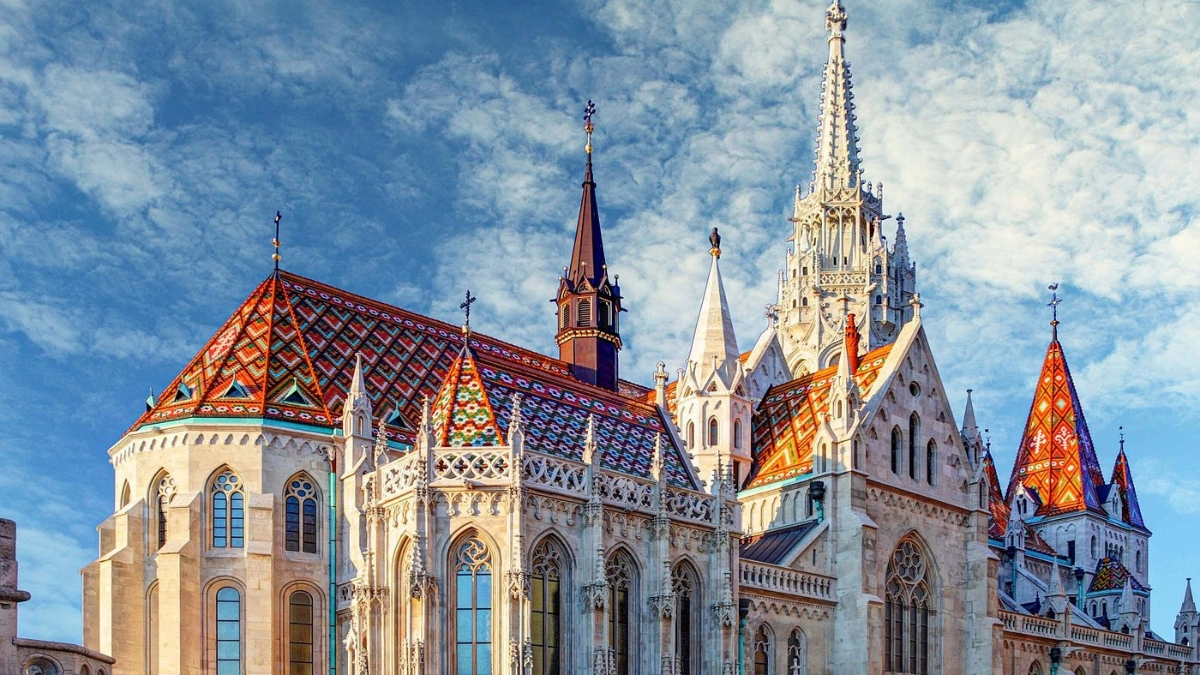
Matthias Church (Mátyás-templom) is the Gothic parish church on Castle Hill, instantly recognizable by its diamond-patterned Zsolnay-tile roof and openwork spire. It’s named for King Matthias Corvinus, hosted the coronations of the last two Habsburg kings of Hungary, and today is both an active place of worship and a ticketed sight with frescoed interiors, a small museum-treasury, and views right next to Fisherman’s Bastion.
Matthias Church sits at the heart of Castle Hill’s Trinity Square, close enough to Fisherman’s Bastion that most visitors see the two together, and close enough to Buda Castle itself to fold into the same walk up the hill. Its roof — glazed diamond and herringbone tiles from the Zsolnay factory in Pécs — is one of the most photographed rooflines in Budapest, but the building’s history runs far deeper than the postcard shot: a medieval parish church, a mosque under Ottoman rule, a Habsburg coronation church, and a 19th-century restoration that gave it the Romantic-nationalist look it wears today.
This guide covers what the church is, why it looks the way it does, what’s inside, and the practical details — hours, tickets, dress, and how much time to allow — for visiting it respectfully as both a historic monument and a working church.
What Is Matthias Church?
Matthias Church is a Roman Catholic parish church on Castle Hill, formally the Church of Our Lady, but universally known by the nickname of King Matthias Corvinus, who held his wedding there and added its tallest tower. It stands on Trinity Square, directly beside Fisherman’s Bastion and a short walk from Buda Castle.
Its official name is the Church of Our Lady (Nagyboldogasszony-templom), but almost nobody uses that name — it’s known everywhere as Matthias Church after King Matthias Corvinus, Hungary’s great Renaissance-era monarch, who married here and whose personal coat of arms still decorates the south tower named for him. The church has stood on this spot in some form since the 13th century, rebuilt and altered repeatedly as royal and religious fortunes on Castle Hill rose and fell. What visitors see today is largely a 19th-century vision of what a medieval Hungarian royal church should look like, built on genuinely medieval foundations and incorporating surviving original stonework.
Architecturally it’s a Gothic hall church with later Baroque and neo-Gothic layers, dominated by a tall, intricately pierced spire and, above all, that roof. The Zsolnay tiles were a nod to Hungarian craft and national identity as much as decoration, and the diamond pattern in ochre, green, and blue has become one of the defining images of Castle Hill, visible from across the Danube in Pest.
A History of Kings, Mosques, and Coronations
The church has been a royal wedding venue, an Ottoman mosque, a site of two Habsburg coronations, and a ruin restored from the ground up in the 19th century by architect Frigyes Schulek — a history that layers medieval, Ottoman, Baroque, and Romantic-nationalist Hungary into a single building.
The first church on this site dates to the 13th century, built after the Mongol invasion of 1241–42 devastated the region and King Béla IV fortified Castle Hill as a result — the same wave of building that produced the original royal residence nearby. Over the following two centuries the church was expanded and rebuilt, reaching a high point under King Matthias Corvinus in the 15th century, when it served as a royal chapel and gained the bell tower that still bears his name and coat of arms.
The Ottoman conquest of Buda in 1541 changed the building’s function entirely: it was converted into the city’s main mosque, its Christian frescoes plastered over or destroyed, and it remained a mosque for roughly a century and a half. When Buda was recaptured from the Ottomans in 1686, the church reverted to Christian use, but the fighting and the centuries of neglect that followed left it in poor condition, patched up in a mostly Baroque style that obscured much of its original Gothic character.
The building most visitors see today is the product of a major late-19th-century restoration led by architect Frigyes Schulek, carried out alongside his design of the adjacent Fisherman’s Bastion. Schulek’s work was less a simple repair than a reimagining — he stripped away later additions, rebuilt sections based on archaeological evidence and educated guesswork, and added the elaborate roof tiling and much of the spire’s ornamentation, producing the Romantic-nationalist landmark that stands today. It’s worth knowing this going in: much of what looks “medieval” at first glance is 19th-century interpretation of the medieval original, though genuine Gothic elements survive throughout, particularly in parts of the stonework and portals.
The church’s grandest historical moments came from two Habsburg coronations. Franz Joseph I was crowned King of Hungary here in 1867, a ceremony tied to the Austro-Hungarian Compromise that created the dual monarchy, with composer Franz Liszt writing his Coronation Mass for the occasion. Charles IV, the last Habsburg to rule Hungary, was crowned here in 1916, the final coronation to take place in the church and one of the last of its kind in Europe. Both events are part of why Matthias Church carries a status well beyond an ordinary parish church.
Inside the Church: Frescoes, Crypt & Treasury
The interior is covered almost floor to ceiling in colorful, Romantic-nationalist frescoes and stenciled patterns from the Schulek-era restoration, a striking contrast to the plainer Gothic exterior. A small crypt and treasury display ecclesiastical artifacts, replicas of the Hungarian coronation regalia, and stonework fragments, and the stained glass adds further color throughout the nave.
Step inside and the church feels almost the opposite of its stone exterior: nearly every surface — walls, columns, vaulted ceilings — is painted in dense, colorful decorative patterns, floral motifs, and figurative frescoes, largely the work of 19th-century Hungarian artists Bertalan Székely and Károly Lotz working under Schulek’s restoration program. The effect is deliberately medieval-inspired but unmistakably a product of Romantic nationalism, the same 19th-century movement that shaped much of Castle Hill’s current appearance — an attempt to visualize a glorious Hungarian past as much as to restore an actual building. Stained glass windows, added or restored in the same era, filter colored light across the painted surfaces, especially striking on a sunny afternoon.
Down a set of stairs, a small crypt and ecclesiastical treasury display religious artifacts, vestments, and stonework — including carved fragments recovered during restorations and excavations that hint at the building’s earlier medieval phases. The treasury also holds replicas of the Hungarian coronation regalia (the originals are kept at the Hungarian Parliament Building), a nod to the church’s coronation history. It’s a modest collection compared to a major museum, but it rewards visitors who want more than the nave alone, and it’s usually included in the standard admission ticket.
Look, too, for surviving original medieval elements amid the 19th-century work: parts of the south portal and scattered stonework predate the Schulek restoration and offer a glimpse of the Gothic church before its Ottoman and Baroque detours.
Visiting: Hours, Tickets & Etiquette
Matthias Church is an active parish church and charges an entry fee for tourist visits outside of service times, when the nave is closed to sightseeing. Expect roughly 30–45 minutes for a visit, dress modestly, keep voices down, and check the schedule if your visit falls during Mass or a wedding, when access for tourists is limited.
Matthias Church functions as a working Catholic parish, and that comes first: Mass and other services take priority over sightseeing, and the church closes to tourist visits during them. Outside service times, entry is ticketed, with the fee covering the nave, the crypt and treasury, and — depending on the ticket — access up into the tower for rooftop views over Castle Hill. Hours run through the day but are shorter than the free-to-roam castle grounds nearby, and they can shift around religious holidays and for private events such as weddings and concerts, which are fairly common here given the setting. If your visit coincides with a service, plan to either attend respectfully as you would any church service (without wandering as a sightseer) or return later in the day.
Because it remains a place of worship, the usual church etiquette applies: modest dress (covered shoulders, no beachwear), quiet voices, no eating or drinking inside, and care with photography — flash and tripods are typically restricted, and some areas may be off-limits to cameras. Most visitors comfortably see the nave, crypt, and treasury in 30 to 45 minutes; add extra time if you’re climbing the tower or if a free organ recital or evening concert happens to be scheduled, which is worth checking for in advance since the acoustics are excellent.
How Matthias Church Fits With the Rest of Castle Hill
Matthias Church sits directly beside Fisherman’s Bastion and a short walk from Buda Castle itself, so nearly every visitor combines the three. The church is ticketed separately from both the bastion’s paying towers and the castle’s museums — there’s no single combined ticket covering everything on the hill.
Matthias Church is the anchor of Trinity Square, and its neighbor, Fisherman’s Bastion, is arguably even more photographed thanks to its fairy-tale turrets and Danube-facing terraces. The two sit close enough that a single stop on Castle Hill naturally takes in both, and many walking tours pair them explicitly. From there it’s a straightforward walk south along the hill to Buda Castle’s courtyards and museums, all part of the same UNESCO-listed Castle Hill district. Keep in mind that each attraction here has its own separate ticket: the church fee doesn’t cover the bastion’s paid upper towers, and neither covers the museums inside Buda Castle, such as the Hungarian National Gallery. Budget your time and euros accordingly if you want to see everything in one day. For the full lay of the land, see our guide to nearby attractions, and if you’d rather have a guide narrate the history in person, a combined tour of the hill covers both the church and the bastion together.
Frequently Asked Questions
What is Matthias Church known for?
It’s known for its colorful, diamond-patterned Zsolnay-tile roof, its Gothic architecture reshaped by a major 19th-century restoration, and its history as the coronation church of the last two Habsburg kings of Hungary, Franz Joseph I in 1867 and Charles IV in 1916.
Why is it called Matthias Church?
It’s named for King Matthias Corvinus, the 15th-century Hungarian king who married in the church and added the tower that still carries his name and coat of arms. Its official name is the Church of Our Lady, but the nickname has stuck for centuries.
Is Matthias Church still an active church?
Yes. It’s a functioning Roman Catholic parish that holds regular Mass and hosts weddings and concerts, in addition to being open to ticketed sightseeing outside service times. Visitors should treat it with the respect due an active place of worship, not purely as a tourist attraction.
Do you need a ticket to enter Matthias Church?
Yes, tourist entry outside of service times requires a paid ticket, which typically covers the nave, crypt, and treasury; a tower climb may be a separate or upgraded ticket. The church is closed to sightseeing during Mass and other services.
Was Matthias Church ever a mosque?
Yes. During roughly a century and a half of Ottoman rule following the 1541 conquest of Buda, the church was converted into the city’s main mosque, and its Christian decoration was removed or covered. It reverted to Christian use after Buda was recaptured in 1686.
What is the significance of the roof?
The roof’s diamond and herringbone pattern of glazed Zsolnay tiles, added during the 19th-century Schulek restoration, has become one of Castle Hill’s signature images and a symbol of Hungarian craftsmanship. It’s especially striking from viewpoints across the Danube in Pest.
How much time should I spend at Matthias Church?
Most visitors need about 30 to 45 minutes for the nave, crypt, and treasury. Add more time if you climb the tower, attend a concert, or want to linger over the frescoes, and pair it with a stop at neighboring Fisherman’s Bastion for a fuller Castle Hill visit.
Is Matthias Church part of Buda Castle?
Not technically — it’s a separate building and a separate ticket from the Buda Castle palace complex, though both sit on the same Castle Hill and are part of the same UNESCO World Heritage Site. Most itineraries combine them in a single walk.
What should I wear to visit?
Modest dress is expected since it’s an active church: covered shoulders and no beachwear or swimwear. Comfortable shoes also help, since Castle Hill’s cobblestones and slopes make for an uneven walk between sights.
Can I take photos inside?
Photography is generally allowed in the nave, but flash, tripods, and photography during services are typically restricted, and some areas of the crypt or treasury may have their own rules. Follow any posted signage or staff guidance once inside.
