

Buda Castle First-Timer Tips: Everything You Need to Know
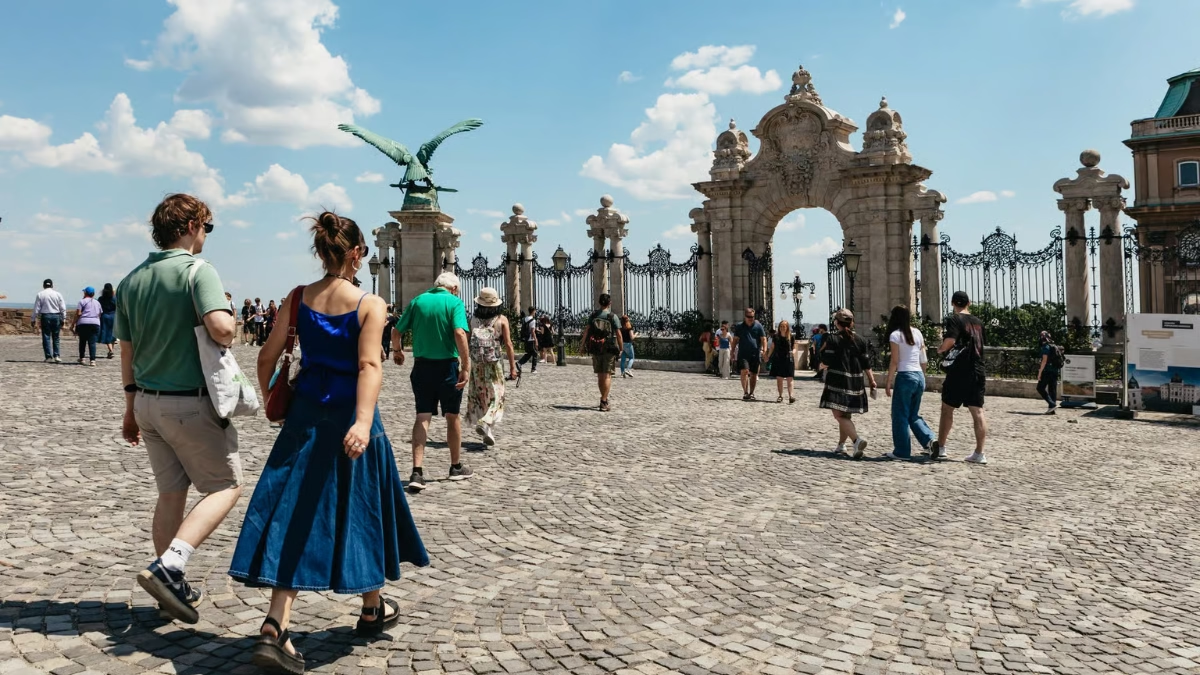
The single most important thing to know is that the Buda Castle grounds — courtyards, terraces, and viewpoints — are free and open 24/7, while only the museums inside (Hungarian National Gallery, Budapest History Museum, Saint Stephen’s Hall) require tickets and close on Mondays. Wear comfortable shoes for the cobblestones and slopes, get up the hill by funicular, bus, or on foot, and don’t confuse Buda Castle with the nearby Fisherman’s Bastion and Matthias Church — all three sit on Castle Hill but are separate sights.
If this is your first visit to Buda Castle, a little orientation goes a long way. It is easy to arrive expecting a single ticketed attraction and instead find a whole hilltop district — a former royal palace, a walled old town, several independent museums, and a cluster of famous landmarks that are not actually part of the castle at all. None of that is a problem once you know what you’re looking at.
This guide runs through the practical do’s and don’ts: what’s free, what’s ticketed, when things close, how to get up the hill, what to wear, when to go for the best light and fewest crowds, where to eat without overpaying, how to handle cash and cards, and how to stay safe on the trams and buses that get you there. Think of it as the briefing a well-traveled friend would give you the night before.
The Biggest Tip: The Grounds Are Free and Never Close
The palace grounds, courtyards, terraces, and viewpoints are public space — free to enter, open 24 hours a day, every day of the year. Only the attractions inside the buildings are ticketed. There is no gate, turnstile, or general admission fee for Buda Castle itself.
If you take away one thing from this guide, make it this: you do not need a ticket to visit Buda Castle. The palace complex sits on public land, and its courtyards, terraces, stairways, and viewpoints over the Danube are open around the clock at no charge. You can walk in at sunrise, at midnight, or on a Monday when every museum in the building is shut, and the experience of simply being on the hilltop costs nothing.
What does require a ticket are the specific institutions housed inside the palace: the Hungarian National Gallery, the Budapest History Museum (also called the Castle Museum), the National Széchényi Library, and the reconstructed Saint Stephen’s Hall, which is seen only on a timed guided tour. There is no single “Buda Castle ticket” that covers all of them — each is a separate admission. Many first-timers arrive expecting one combined entry fee and are pleasantly surprised to learn the grounds themselves are simply open. For the full breakdown of who charges what, see our guide to Buda Castle ticket prices.
Know Before You Go: What’s Ticketed vs. What’s Free
- Free, always: the palace courtyards, terraces, gardens, stairways, gates, fountains, and every panoramic viewpoint over the Danube and Pest.
- Ticketed: the Hungarian National Gallery (Hungarian art), the Budapest History Museum (the palace’s own history and archaeology), the National Széchényi Library (a research library, not a typical sightseeing stop), and Saint Stephen’s Hall (guided tour only, reopened in 2021 after a full reconstruction of the ceremonial royal room).
- Not part of Buda Castle at all, despite being nearby: Fisherman’s Bastion and Matthias Church (see below).
Don’t Confuse Buda Castle with Fisherman’s Bastion or Matthias Church
Buda Castle, Fisherman’s Bastion, and Matthias Church all sit on Castle Hill but are three separate sights with separate histories, separate admission rules, and a 10–15 minute walk between them. Buda Castle is the former royal palace at the southern end of the hill; Fisherman’s Bastion and Matthias Church are a fairy-tale-looking terrace and a church at the northern end, near Trinity Square.
This is the mix-up that trips up more first-timers than anything else. Many travelers arrive expecting Buda Castle to mean the pointed white towers and the ornate church spire seen in postcards — but that’s Fisherman’s Bastion (Halászbástya) and Matthias Church (Mátyás-templom), which stand together near the Holy Trinity Square, a walk of roughly 10 to 15 minutes north of the palace. Buda Castle is the large Baroque palace complex at the opposite end of Castle Hill, overlooking the river from the south.
All three are worth seeing, and pairing them into one visit is the natural way to spend a day on Castle Hill, but they are run separately, priced separately, and photographed for very different reasons — the palace for its scale, history, and museums; the Bastion for its turrets and panoramas; the church for its colorful roof tiles and interior. Our nearby attractions guide covers the full Castle Hill lineup, and if you’d rather have someone walk you through all three in one go, the St. Stephen’s Hall Tour combines palace highlights with the hall, while a dedicated Castle Hill walk pairs the palace with the Bastion and church.
The Monday Museum Closure
The Hungarian National Gallery, the palace’s main museum, closes on Mondays, and the Budapest History Museum generally follows the same schedule. The grounds stay open on Mondays regardless, so it’s still a fine day to visit — just not for the museum interiors.
Plan around this one deliberately. If a museum visit is the centerpiece of your trip, avoid landing on Castle Hill on a Monday, when the Hungarian National Gallery and Budapest History Museum are typically closed (some institutions make exceptions for holiday Mondays). If Monday is the only day that works with your itinerary, treat it as a grounds-and-viewpoints day instead — walk the terraces, take photos, see Fisherman’s Bastion and Matthias Church, and save the museums for another day if you can. Full hour-by-hour detail, including winter reductions, is in our opening hours guide.
How to Get Up the Hill
Castle Hill is largely closed to private cars, so you’ll be arriving on foot, by funicular, or by bus. The Budavári Sikló (funicular) climbs from Clark Ádám tér, right by the Chain Bridge, up to the palace terrace in about a minute — it’s scenic, but it’s also the most crowded option and the only one that charges a fare. Bus 16 and its variants 16A/116 run from Deák Ferenc tér and Széll Kálmán tér (an M2 metro stop) up onto the hill and are cheaper and less crowded than the funicular. You can also simply walk up, either via the castle stairs near the funicular or from the Vienna Gate side near Széll Kálmán tér — free, and a good warm-up for the cobbles ahead. Whichever you choose, remember that reaching the hill itself is free; you’re only paying for transport, not for entry. Our getting there guide compares all three in detail.
Wear Comfortable Shoes: The Cobbles Are Real
Castle Hill is paved almost entirely in cobblestone, and the palace grounds involve slopes, stairs, and uneven surfaces throughout. Heels, flip-flops, and worn-out soles are a genuinely bad idea here — comfortable, flat, closed-toe walking shoes make the difference between an enjoyable few hours and a painful one. This matters even more if your day includes the walk up from the Chain Bridge, a stroll to Fisherman’s Bastion, or a full loop of the district, which together can add up to several kilometers of walking on uneven ground. If mobility is a concern for anyone in your group, our accessibility guide covers step-free routes and what to expect.
Best Times to Visit for Light and Crowds
Early morning and the golden hour before sunset offer the best light and the smallest crowds on the grounds, since the terraces are open around the clock but tour groups mostly arrive mid-morning through early afternoon. For museum visits, aim for a weekday soon after the 10 AM opening.
Because the grounds never close, you’re not locked into museum hours to enjoy the castle. Arriving early morning — before the coach tours reach the hill — gets you quiet courtyards and soft light for photos. Late afternoon into evening is the other sweet spot: warm light over the Danube, and after dark, the palace and city are beautifully floodlit, with a fraction of the daytime foot traffic. If a museum is on your list, go on a weekday morning shortly after opening rather than midday or on a weekend, when Castle Hill gets its heaviest crowds. For a season-by-season breakdown, see best time to visit.
Where to Eat (and Where Not to Overpay)
Castle Hill has restaurants and cafés, but as with most concentrated tourist districts, prices climb the closer you sit to the main viewpoints and the palace entrance — expect to pay a premium for a table with a Danube view. If you’re budget-conscious, it’s worth eating a real meal down in the Víziváros (Watertown) neighborhood at the base of the hill, or across the river in Pest, and treating anything you buy on the hilltop itself — coffee, ice cream, a quick snack — as the price of the view rather than a bargain. Menus posted outside are generally honest in Hungary, but it’s still smart to check prices before sitting down, particularly at spots directly facing Fisherman’s Bastion or the palace terraces, which tend to be the most marked up.
Cash, Cards, and ATMs
Hungary uses the forint (HUF), not the euro, and while major cards are widely accepted at museums, restaurants, and ticket counters on Castle Hill, it’s worth carrying some cash for smaller vendors, market stalls, or public restrooms that may be cash-only. Use bank-affiliated ATMs where possible rather than the standalone currency-exchange-style machines that sometimes appear in tourist areas and add poor exchange rates or extra fees — if a machine offers to charge you in your home currency (“dynamic currency conversion”), decline and choose to be charged in forint instead. Avoid exchanging money at kiosks advertising conspicuously good rates in heavily touristed spots; it’s usually a sign the real rate is worse than it looks.
Safety and Pickpockets on Public Transport
Budapest is generally a safe city for visitors, but the routes up to Castle Hill — particularly crowded buses and the funicular during peak hours — are known spots for pickpocketing, as is true of dense tourist transport corridors in most major European cities. Keep bags zipped and worn in front of you on crowded buses, be extra aware during the jostle of boarding and alighting, and avoid keeping a wallet or phone in a back pocket. None of this should discourage you — it’s ordinary big-city caution rather than a specific warning about Budapest — but it’s worth a moment’s thought before you’re squeezed onto a packed bus with a group of visitors.
Combining Sights: How to Plan Your Day
Buda Castle pairs naturally with the rest of Castle Hill. A sensible first-timer route is to arrive early via funicular or bus, explore the free grounds and viewpoints while the light and crowds are best, visit a museum if one interests you, then walk north through the old town to Fisherman’s Bastion and Matthias Church before heading back down. Budget at least half a day for the grounds plus one museum, and closer to a full day if you want to see the whole hill without rushing. Our how long to spend guide breaks down timing for different kinds of visits, and what’s inside Buda Castle gives a fuller sense of what each museum actually offers before you decide whether to buy a ticket.
Photography Tips
The best unobstructed views over the Danube, the Chain Bridge, and Parliament are from the palace terraces on the river-facing side, and they’re at their most dramatic in early morning or late-afternoon light rather than the flatter light of midday. Because the grounds are open 24/7, a pre-dawn or after-dark visit is entirely possible if you want the terraces without a single other tourist in frame — the floodlit palace and skyline after sunset are a favorite among photographers for exactly this reason. If you’re set on capturing the castle itself rather than just the views from it, allow some space in your frame — the building’s scale is hard to convey from close up, and stepping back toward the garden areas or approaching from Clark Ádám tér below gives a fuller sense of it. For more on where to stand for the classic shots, see our grounds and viewpoints guide.
First-Timer Do’s and Don’ts
Do remember the grounds are free and open every day, at every hour. Do wear flat, comfortable shoes for the cobblestones and slopes. Do check museum hours in advance and avoid planning a Monday museum visit. Do carry some forint cash alongside a card, and use bank ATMs. Do go early or late in the day for the best light and smallest crowds. Don’t assume Fisherman’s Bastion and Matthias Church are part of Buda Castle — they’re separate sights nearby. Don’t expect a single combined “Buda Castle ticket”; each museum is its own admission. Don’t sit down at the first river-view restaurant you see without checking the menu first. Don’t keep your wallet or phone somewhere easy to reach on a crowded bus or the funicular.
Frequently Asked Questions
Do I need a ticket to visit Buda Castle?
No. The palace grounds, courtyards, and terraces are free and open 24 hours a day. You only need a ticket for the attractions inside, such as the Hungarian National Gallery or the Budapest History Museum.
Is Buda Castle the same as Fisherman’s Bastion?
No. They are separate sights on the same Castle Hill, about a 10 to 15 minute walk apart. Buda Castle is the former royal palace; Fisherman’s Bastion is a lookout terrace near Matthias Church at the opposite end of the hill.
What should I wear to visit Buda Castle?
Comfortable, flat, closed-toe walking shoes are the priority, since Castle Hill is paved in cobblestone and involves stairs and slopes. Layers are also useful, since it can be windier and cooler on the exposed terraces than in the streets below.
Is Buda Castle open on Mondays?
The grounds are open every day, including Mondays, but the Hungarian National Gallery and Budapest History Museum are typically closed on Mondays. Plan a Monday visit around the free grounds and viewpoints rather than the museums.
How do I get up to Buda Castle?
The funicular from Clark Ádám tér near the Chain Bridge is the classic scenic route, bus 16 (and 16A/116) is cheaper and less crowded, and you can also walk up the castle stairs or approach roads for free. Castle Hill itself is largely closed to private cars.
Is it safe to visit Buda Castle?
Yes, Budapest and Castle Hill are generally safe for visitors. The main precaution is against pickpocketing on crowded buses and the funicular, which is ordinary big-city caution rather than a specific risk unique to the castle.
Should I use cash or card at Buda Castle?
Cards are widely accepted at museums and restaurants, but it’s worth carrying some Hungarian forint in cash for smaller vendors. Use bank-affiliated ATMs rather than standalone exchange-style machines, and decline any offer to be charged in your home currency.
When is the best time of day to visit for photos?
Early morning and the hour before sunset give the best light and the fewest people, especially on the river-facing terraces. Because the grounds never close, an after-dark visit to see the floodlit palace is also worth considering.
How much time should I plan for a first visit?
Set aside at least half a day if you want to see the grounds plus one museum, and closer to a full day if you’re combining the palace with Fisherman’s Bastion and Matthias Church. Add more time if you plan to eat a full meal on the hill.
Can I combine Buda Castle with Fisherman’s Bastion and Matthias Church in one visit?
Yes, and most first-timers do. The three sights sit within easy walking distance of each other on Castle Hill, making a combined half-day or full-day itinerary the most efficient way to see the district.
