

Budapest History Museum Buda Castle: What’s Inside & Hours
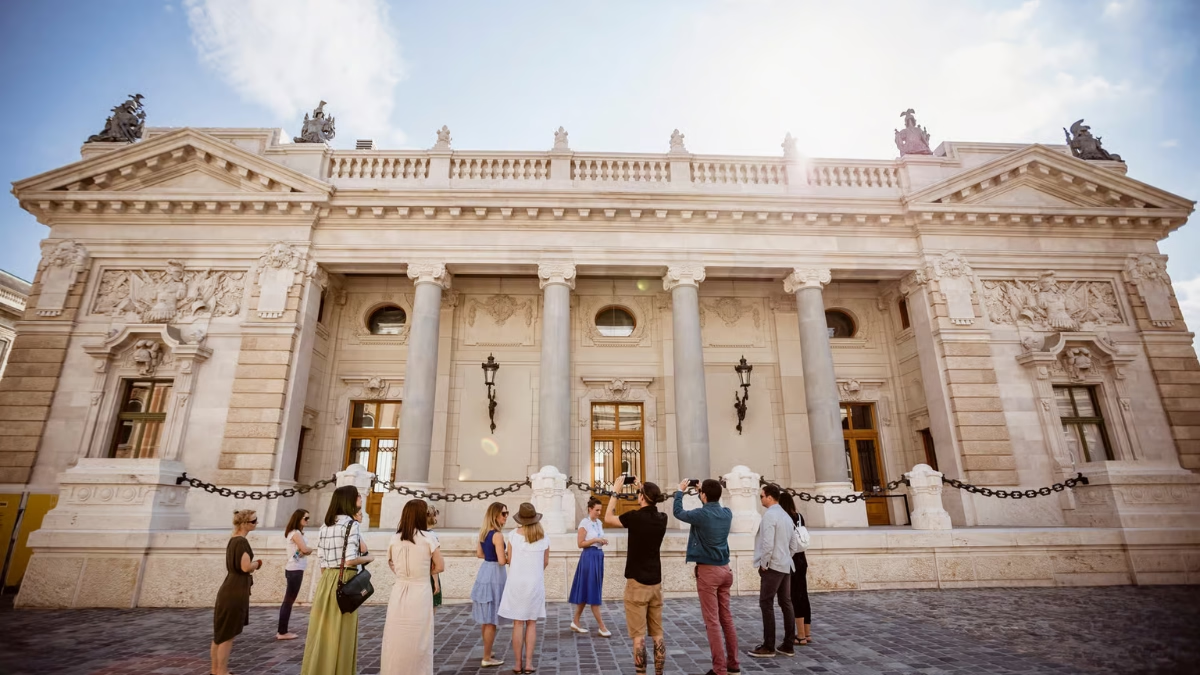
The Budapest History Museum (Budapest Történeti Múzeum), also called the Castle Museum, occupies Building E of the palace and tells the story of Budapest across 2,000 years — from Roman Aquincum through medieval Buda to the modern city. Its standout draw is the medieval royal palace itself: excavated Gothic statues, vaulted cellars, and a reconstructed chapel from the court of the Angevin and Hunyadi kings. Plan on 1.5 to 2 hours, and know that it rewards history-minded visitors more than those chasing fine art, who are usually better served by the Hungarian National Gallery next door.
Of the two big museums inside Buda Castle, the Budapest History Museum is the one most visitors know least about — and the one most tied to the building it sits in. Rather than a collection assembled from elsewhere, much of what’s on display was found on this exact hill: statues buried by fleeing courtiers, cellar vaults sealed for centuries, and palace foundations rebuilt after the 1944–45 siege left the site in ruins. It’s less flashy than a gallery of paintings, but for anyone curious about what actually stood on this hill before the Habsburgs, the Ottomans, or the 20th century got to it, it’s the most direct link to that history.
This guide covers what’s inside, how the museum is laid out, how long to budget, current hours and ticket prices, and an honest take on who gets the most out of a visit.
What Is the Budapest History Museum?
The Budapest History Museum, also known as the Castle Museum (Vármúzeum), is the Buda Castle museum dedicated to the city’s own past rather than fine art. It occupies Building E, the southern wing of the palace, and combines excavated medieval remains with chronological exhibitions covering everything from Roman-era Aquincum to 20th-century Budapest.
Confusingly, Buda Castle holds two large museums, and it’s easy to mix them up. The Hungarian National Gallery, in the central and northern wings, is an art museum — Hungarian paintings, sculpture, and altarpieces. The Budapest History Museum, run by the same institution that manages much of the city’s archaeology, is a history museum: it explains how the hill, the palace, and the city around it came to be. If you’re picturing oil paintings and expecting to find them here, you’ll be disappointed; if you want to understand what actually happened on this ground, this is the museum for you. Our overview of what’s inside Buda Castle breaks down how all the palace’s attractions relate to each other.
The museum’s great advantage is location. Because it sits inside the surviving lower floors and cellars of the medieval royal palace — parts of the building that predate the Habsburg-era rebuilding above — a large share of the exhibition isn’t a display case of artifacts moved in from elsewhere. It’s the building itself: Gothic hall foundations, chapel walls, and storage cellars that archaeologists uncovered largely intact after WWII bomb damage exposed the medieval layers beneath the later palace.
Highlights: What You’ll Actually See
The core of the visit is the excavated medieval palace itself — the surviving Gothic halls, foundations, and cellars of the royal residence built up under Sigismund of Luxembourg and Matthias Corvinus, rediscovered after WWII damage exposed them beneath the later Baroque and 20th-century palace.
The Medieval Royal Palace Remains
Buda Castle as it stands today is largely a Baroque-and-later reconstruction, but underneath and within it survive real fragments of the medieval royal palace that once made Buda one of the great courts of Central Europe. The 1944–45 siege that gutted the palace also, in a strange way, opened the door to archaeology: with the upper floors destroyed, excavators were able to reach medieval levels that had been built over for centuries. What visitors walk through today are the results — vaulted rooms, stone doorways, and wall fragments from the 14th and 15th centuries, presented largely as they were found rather than dressed up as a period recreation.
Gothic Statues Found in the Excavations
One of the museum’s best-known holdings is a cache of Gothic statues and sculpture fragments unearthed during 20th-century excavations of the palace grounds — believed to have been buried for safekeeping centuries ago and rediscovered largely intact.
Among the more remarkable finds displayed here are a group of Gothic statues and carved fragments — courtly and religious figures — that came out of the ground during excavation of the palace gardens in the 20th century. The leading theory is that they were buried deliberately, likely during a period of danger to the court, and simply never retrieved. Seeing genuine 14th- and 15th-century sculpture that spent centuries underground before turning up a few dozen meters from where it originally stood is one of the more striking experiences in the whole museum, and it’s the kind of exhibit that doesn’t really exist anywhere else in Budapest.
The Reconstructed Medieval Cellars and Chapel
The museum’s lower levels include reconstructed medieval cellars and a chapel space from the royal palace’s Gothic-era core, giving a sense of the building’s layout before it was rebuilt in later centuries.
Below the main exhibition floors, the museum incorporates a run of medieval cellars and a chapel that belonged to the Gothic-period palace. These spaces are more atmospheric than object-heavy — stone vaults, worn steps, and a hushed, low-ceilinged feel that contrasts with the grander Baroque halls above ground. It’s worth noting these are a separate attraction from the Buda Castle Labyrinth, the underground tunnel network that runs beneath the hill and is ticketed and operated independently — the museum’s cellars are part of the palace building itself, not the wider cave system under Castle Hill.
The 2,000-Year Story of Budapest
Beyond the palace remains, the museum’s chronological galleries trace Budapest’s history from the Roman settlement of Aquincum, through medieval and Ottoman-era Buda, to the modern, unified city — using archaeology, models, and everyday objects rather than paintings.
The rest of the museum is organized as a walk through the city’s history in roughly chronological order. It opens with the Roman era, when the Aquincum settlement on the Buda side (today a separate archaeological site and museum in Óbuda) was a provincial capital of real size, and continues through the founding of the medieval town on Castle Hill after the Mongol invasion, the Ottoman occupation and its aftermath, and the 19th-century unification of Buda, Pest, and Óbuda into modern Budapest. Expect models, maps, coins, tools, and domestic objects rather than fine art — it’s a museum about how people lived and how the city grew, not a gallery of masterpieces.
Layout and How Long You Need
Budget 1.5 to 2 hours for a proper visit — enough to see the medieval palace remains, the Gothic statue collection, and at least a skim through the chronological galleries. History enthusiasts and slow readers of exhibition text should lean toward the higher end.
The museum spreads across several floors and wings of Building E, moving between ground-level and below-ground spaces as you follow the medieval remains, so expect some stairs and a layout that isn’t a single straight loop. Most visitors need 1.5 to 2 hours to see the palace remains, the statue collection, and the historical galleries without rushing. If you’re short on time and mainly want the medieval highlights, you can move faster and still catch the best of it in under an hour, but you’ll skip a lot of the chronological context on the way up to the modern city. For a broader sense of how this fits into a full Castle Hill day, see our guide on how long to spend at Buda Castle.
Hours and Tickets
The Budapest History Museum generally opens Tuesday through Sunday, closing on Mondays, with hours reduced in the winter months. A standard adult ticket runs around HUF 3,000 (2026 pricing), separate from the Hungarian National Gallery and Saint Stephen’s Hall tickets.
The museum keeps roughly the same weekly rhythm as the rest of the palace’s attractions: open Tuesday to Sunday, closed on Mondays, with last entry typically before the posted closing time. Hours are noticeably shorter in winter than in the main season, and can shift around Hungarian public holidays, so if you’re visiting between November and February it’s worth double-checking the current schedule rather than assuming summer hours apply. See our full breakdown of Buda Castle’s opening hours for the seasonal pattern across all the palace’s museums.
A standard adult ticket costs approximately HUF 3,000, though exact pricing shifts with the forint’s exchange rate and the museum periodically runs temporary exhibitions with their own admission or combined pricing. There’s no single “Buda Castle ticket” that covers every attraction — the museum, the National Gallery, and the Saint Stephen’s Hall tour are each ticketed separately. Our guide to Buda Castle ticket prices lays out current costs across all the palace’s paid attractions, including any combination or discount options.
Is the Budapest History Museum Worth It?
It’s genuinely worth it for history buffs, archaeology fans, and anyone curious about medieval Buda — the palace remains and Gothic statues aren’t replicated anywhere else. Visitors mainly after fine art or a highlight-reel museum experience are usually better served spending that time and ticket budget at the Hungarian National Gallery instead.
Here’s the honest trade-off. The Budapest History Museum’s strength is authenticity: you’re standing in and among genuine medieval palace fabric, not a themed reconstruction, and the Gothic statues are a find you won’t see duplicated in any other Budapest museum. If you enjoy the “detective work” side of history — reading how archaeologists pieced a destroyed building back together — this museum delivers in a way few sites in the city can match.
Its weakness is presentation pace. The chronological galleries covering 2,000 years in one sweep can feel dense if you’re not already interested in the subject, and unlike the Hungarian National Gallery, there’s no big-name painting or instantly recognizable masterpiece to anchor a quick visit. Visitors who want striking visuals and a shorter, more curated experience — especially anyone traveling with kids who need faster pacing — often get more out of the National Gallery or simply enjoying the free grounds and viewpoints outside. If you only have time and budget for one paid museum inside the palace and history genuinely interests you, this is a strong choice; if you’re deciding purely on “what will look best in photos,” the Gallery or the terraces will likely win.
Frequently Asked Questions
What is the Budapest History Museum inside Buda Castle?
It’s the museum dedicated to Budapest’s history, also called the Castle Museum, located in Building E of the palace. It combines excavated remains of the medieval royal palace with chronological exhibitions covering the city from Roman Aquincum through medieval Buda to the modern era.
Is the Budapest History Museum the same as the Hungarian National Gallery?
No. They’re two separate museums in different wings of Buda Castle. The National Gallery is an art museum focused on Hungarian painting and sculpture, while the Budapest History Museum is a history and archaeology museum focused on the city’s past and the medieval palace itself.
How long does it take to visit the Budapest History Museum?
Most visitors need 1.5 to 2 hours to see the medieval palace remains, the Gothic statue collection, and a reasonable pass through the historical galleries. You can move faster if you’re only after the medieval highlights, but expect to miss some of the chronological context.
What are the highlights of the Budapest History Museum?
The standout highlights are the excavated remains of the medieval royal palace, a collection of Gothic statues found buried on the palace grounds, and reconstructed medieval cellars and a chapel from the Gothic-era court. The chronological galleries covering Roman-era Aquincum through modern Budapest round out the visit.
What are the Budapest History Museum’s opening hours?
It generally opens Tuesday through Sunday and closes on Mondays, similar to the Hungarian National Gallery, with hours reduced in winter. Confirm the current schedule on the official site before visiting, especially outside the main summer season.
How much does a ticket to the Budapest History Museum cost?
A standard adult ticket costs approximately HUF 3,000 as of 2026, though pricing can shift with the exchange rate and temporary exhibitions. This is a separate ticket from the National Gallery and the Saint Stephen’s Hall tour — there is no single combined “Buda Castle” admission.
Is the Budapest History Museum worth visiting?
For history and archaeology enthusiasts, yes — the medieval palace remains and Gothic statues are unique to this museum and aren’t displayed anywhere else. Visitors mainly interested in art or a faster, more visual museum experience are often better served by the Hungarian National Gallery.
Are the medieval cellars the same as the Buda Castle Labyrinth?
No. The museum’s medieval cellars and chapel are part of the palace building itself, in Building E. The Buda Castle Labyrinth is a separate, independently ticketed cave and tunnel system beneath Castle Hill, distinct from the museum’s exhibits.
Do I need to book Budapest History Museum tickets in advance?
Advance booking generally isn’t required for the museum itself, and tickets can typically be bought on-site, though checking current hours before you go is wise since the museum closes on Mondays and trims its hours in winter.
Where is the Budapest History Museum located inside Buda Castle?
It’s in Building E, one of the palace’s wings, reached from within the Buda Castle grounds like the rest of the palace’s ticketed attractions. The grounds themselves are free and open at all hours; only the museum interior requires a ticket.
