

What’s Inside Buda Castle: Every Museum, Hall & Viewpoint
Buda Castle is a whole hilltop complex, not a single attraction. Its free grounds hold courtyards, terraces, viewpoints, the Matthias Fountain, the Lion Courtyard and the Turul statue, all open 24/7 at no cost. Inside the palace building itself, three ticketed institutions charge separate admission — the Hungarian National Gallery, the Budapest History Museum, and the National Széchényi Library — plus Saint Stephen’s Hall, seen on a timed guided tour. The Castle Garden Bazaar sits below the hill and is also free to enter.
First-time visitors are often surprised that there is no single “Buda Castle ticket” and no one queue to join. Buda Castle (Budavári Palota) is a sprawling former royal palace on Castle Hill, part of the Banks of the Danube and Buda Castle Quarter UNESCO World Heritage Site, and it functions more like a small campus than a single museum. Some of it — the outdoor spaces, statues, and views — is public and free at any hour. The rest is split across independent museums and halls, each with its own hours, ticket, and entrance.
This guide maps out everything you’ll find inside and around Buda Castle: what costs nothing, what you have to pay for, and how to prioritize your time if you can’t do it all. For deeper detail on any single piece, we link out to our dedicated guides throughout.
Free vs. Ticketed: The Big Picture
The palace grounds, courtyards, terraces, and outdoor monuments are free and open around the clock. Only what’s housed inside the building requires a ticket: the Hungarian National Gallery, the Budapest History Museum, the National Széchényi Library, and Saint Stephen’s Hall. There is no combined “castle ticket” — each is booked and paid for separately.
This is the single most useful thing to understand before you climb the hill. “Buda Castle” describes the whole hilltop site — grounds included — and most of what makes it photogenic is outdoors and costs nothing. The paid attractions are specific institutions that happen to occupy wings of the same historic building. That means you can have a completely satisfying, free visit to Buda Castle without ever buying a ticket, or you can add one, two, or all three museums depending on your interests and time. See our full breakdown of Buda Castle ticket prices for exact costs, and our guide to free entry and discounts if you’re working with a tight budget.
| Part of Buda Castle | Free or Ticketed | What it is |
|---|---|---|
| Grounds, courtyards, terraces & viewpoints | Free, 24/7 | Public outdoor space, statues, fountains, views |
| Matthias Fountain | Free | Renaissance-themed fountain in the courtyard |
| Lion Courtyard | Free | Courtyard with lion statues, main palace entrance |
| Turul statue | Free | Bronze mythological bird overlooking the Danube |
| Hungarian National Gallery | Ticketed | Hungary’s national collection of fine art |
| Budapest History Museum (Castle Museum) | Ticketed | City and palace history, medieval ruins |
| National Széchényi Library | Ticketed | Hungary’s national library and archive |
| Saint Stephen’s Hall | Ticketed, guided tour only | Restored ceremonial royal hall |
| Castle Garden Bazaar | Free | Historic garden and arcade at the base of the hill |
The Free Grounds, Courtyards & Terraces
The outdoor parts of Buda Castle — the terraces overlooking the Danube, the inner courtyards, and the connecting walkways — are open 24 hours a day and cost nothing to visit. This is where most of the classic photos of Budapest are taken, and it’s enough on its own for a memorable, budget-friendly stop.
For many visitors, the grounds are the actual highlight of Buda Castle, not a consolation prize for skipping the museums. The terraces along the eastern edge of the hill look straight across the Danube to the Chain Bridge, Parliament, and the rooftops of Pest, and they’re just as striking at sunrise or after dark as at midday. Walking between the courtyards costs nothing, has no opening or closing time, and doesn’t require booking anything in advance. Our dedicated guide to Buda Castle grounds & views covers exactly where to stand for the best panoramas and how the light changes through the day.
Matthias Fountain
Set in one of the palace’s inner courtyards, the Matthias Fountain (Mátyás-kút) is a large sculptural group illustrating a Hungarian legend about King Matthias Corvinus on a hunt, with his hunting dogs, huntsmen, and the peasant girl Szép Ilonka who supposedly fell in love with the disguised king. It’s one of the most photographed spots on the hill and, like the rest of the grounds, free to see at any hour.
The Lion Courtyard
The Lion Courtyard (Oroszlános udvar) takes its name from the pairs of stone lions guarding its gates. It’s a central, monumental space in the palace complex and functions today as one of the main approaches to the museum entrances — you’ll likely pass through it whether or not you buy a ticket to go inside.
The Turul Statue
Perched on the northern side of the hill above a dramatic staircase, the Turul is a large bronze statue of a mythological bird of prey from Hungarian folklore, wings outstretched, looking out over the Danube. It’s one of the most recognizable landmarks on Castle Hill and a natural stop for photos on the way up from the funicular or the castle stairs.
Hungarian National Gallery
The Hungarian National Gallery is the country’s principal fine-art museum, occupying several wings of the palace and covering Hungarian art from medieval altarpieces to 20th-century painting. It’s ticketed separately, open Tuesday to Sunday, and closed Mondays.
The Hungarian National Gallery is the largest single reason most travelers buy a ticket at Buda Castle. Its collection spans medieval and Renaissance religious art, Gothic wood carvings, 19th-century Hungarian masters, and modern works, spread across multiple floors with some of the best views in the building from its upper terraces. It keeps standard museum hours (Tuesday to Sunday, 10 AM to 6 PM, shorter in winter) and closes on Mondays. For a room-by-room sense of what’s worth your time, see our guide to the Hungarian National Gallery highlights.
Budapest History Museum (Castle Museum)
The Budapest History Museum, also called the Castle Museum, traces the city’s history from its Roman and medieval roots through the palace’s own destruction and reconstruction, and includes excavated medieval royal rooms in its lower levels. It shares similar hours to the National Gallery but is a separate ticket.
Where the National Gallery is about art, the Budapest History Museum is about the site itself — the medieval royal court, the Ottoman era, and the palace’s repeated destruction and rebuilding, most dramatically in the 1944–45 siege of Budapest. Its lower floors incorporate genuine excavated chambers from the medieval palace, which makes it feel less like a conventional museum and more like walking through the building’s own foundations. It keeps broadly similar hours to the National Gallery but tends to trim them further in winter, so check ahead for a cold-season visit. Our full guide to the Budapest History Museum covers what’s inside floor by floor and whether it’s worth the ticket for your trip.
National Széchényi Library
The National Széchényi Library occupies its own wing of the palace and functions as Hungary’s national library and archive rather than a typical sightseeing stop. It keeps its own weekday-and-Saturday schedule, closed Sunday and Monday, with separate rules for its reading rooms versus any public exhibition spaces. Most visitors won’t need a ticket here unless they have research interests or want to see a specific exhibition — it’s worth knowing it exists inside the complex, but it’s a lower priority than the Gallery or History Museum for a first visit.
Saint Stephen’s Hall
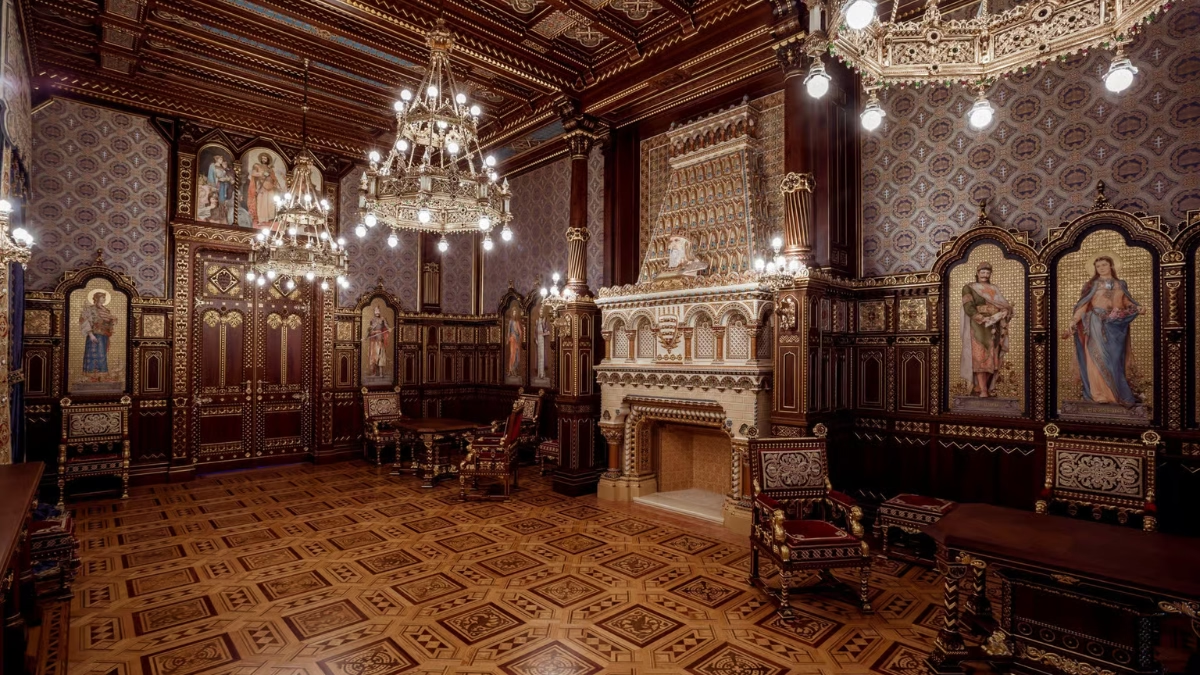
Saint Stephen’s Hall is the palace’s restored ceremonial royal hall, completed in 1902, destroyed in the WWII siege, and reopened in 2021 after reconstruction from historical photographs. It’s the only palace interior returned to its original look, and it’s visited exclusively on a timed guided tour rather than by walk-in entry.
Saint Stephen’s Hall (Szent István-terem) stands apart from the other paid attractions because it isn’t a museum you wander through at your own pace — it’s a single, extraordinary room seen on a guided visit at a scheduled time. Completed in 1902 in a Hungarian historicist style associated with architect Miklós Ybl and his successors, it features a coffered ceiling, gilded ornament, and a Zsolnay majolica fireplace. Reduced to rubble in the 1944–45 siege of Budapest along with most of the rest of the palace, it sat unreconstructed for decades until it was rebuilt from archival photographs and reopened to visitors in 2021, making it the only interior in the palace restored to its original appearance rather than adapted for modern museum use. Because access is by guided tour only, it’s worth booking ahead; our review of the Saint Stephen’s Hall Tour has the full rundown of what the visit includes.
Castle Garden Bazaar (Below the Hill)
At the foot of Castle Hill, along the Danube, the Castle Garden Bazaar (Várkert Bazár) is a restored 19th-century garden and arcade that once served as an ornamental approach to the palace above. Today it’s a free public space with landscaped terraces, cafes, exhibition halls, and event venues, connected to the palace grounds by paths and stairs up the hillside. It’s an easy, no-cost add-on if you’re walking up from the Chain Bridge or the Danube embankment, and a pleasant place to pause before or after tackling the hill itself.
How to Plan Your Visit: What to Prioritize
If your time is limited, the free grounds and viewpoints alone are worth the trip. Add the Hungarian National Gallery if you care about art, the Budapest History Museum if you care about the palace’s own story, and Saint Stephen’s Hall if you want to see the one interior restored to its historic look — but book that tour in advance since it’s guided-only.
With so many independent pieces, it helps to think in tiers rather than trying to see everything on one visit:
- Short on time or budget: Walk the grounds, terraces, Lion Courtyard, Matthias Fountain, and Turul statue. This costs nothing and can be done in under an hour, though most people linger longer for the views.
- Half a day: Add one museum — the Hungarian National Gallery for art, or the Budapest History Museum for the palace’s own history and the excavated medieval rooms.
- A full day on Castle Hill: Combine both museums, add Saint Stephen’s Hall if you book the guided tour in advance, and extend your day to the neighboring sights on the hill, including Fisherman’s Bastion and Matthias Church.
For a fuller time budget by combination, check current opening hours before you go, since museum hours shrink in winter and Mondays close most interiors.
Frequently Asked Questions
What exactly is inside Buda Castle?
Buda Castle contains free outdoor grounds, courtyards, terraces, and monuments like the Matthias Fountain and Turul statue, plus three separately ticketed institutions — the Hungarian National Gallery, the Budapest History Museum, and the National Széchényi Library — and Saint Stephen’s Hall, which is visited on a guided tour. There is no single ticket that covers everything.
Is everything inside Buda Castle free to visit?
No. The grounds, courtyards, terraces, and outdoor statues are free and open 24/7, but the museums and Saint Stephen’s Hall inside the palace building each require their own paid ticket. You can have a full, worthwhile visit using only the free areas if you’d rather not pay for a museum.
What’s the difference between the Hungarian National Gallery and the Budapest History Museum?
The Hungarian National Gallery is a fine-art museum covering Hungarian painting and sculpture from medieval to modern times. The Budapest History Museum, also called the Castle Museum, focuses on the history of the city and the palace itself, including excavated medieval royal rooms. They are separate institutions with separate tickets in the same building.
Can I visit Saint Stephen’s Hall without a guide?
No. Saint Stephen’s Hall is only open through timed guided tours, unlike the National Gallery or History Museum, which you explore at your own pace once inside. Booking ahead is worthwhile since tour times are limited.
Is the National Széchényi Library open to tourists?
It’s open on its own weekday-and-Saturday schedule, but it functions primarily as Hungary’s national library and archive rather than a typical museum stop. Casual visitors are better served by the National Gallery or History Museum unless there’s a specific exhibition or research reason to visit.
Do I need to go to the Castle Garden Bazaar separately?
No, but it’s worth combining with your visit if you’re walking up from the Danube or the Chain Bridge. It sits at the base of the hill, is free to enter, and connects to the palace grounds by paths up the hillside, so it fits naturally into a walking route rather than requiring a separate trip.
What’s the best order to see everything inside Buda Castle?
Most visitors start with the free grounds and viewpoints since they set the scene and cost nothing, then choose one or both museums based on interest, and add Saint Stephen’s Hall last since it requires a pre-booked, timed guided tour. Working outside-in like this avoids wasted time if a museum’s hours don’t line up with your schedule.
How much does it cost to see everything?
Each attraction is priced separately, and there’s no single combined ticket for Buda Castle. Costs vary by institution, so it’s worth checking current prices for the National Gallery, History Museum, and Saint Stephen’s Hall tour before you budget your day.
How long do I need to see everything inside Buda Castle?
The free grounds alone can be seen in under an hour, but add one museum and expect two to three hours; combine both museums and Saint Stephen’s Hall and a full day is realistic once you factor in the hill’s other neighbors. See our guide on how long to spend at Buda Castle for time budgets by combination.
Is Buda Castle worth visiting if I skip the museums entirely?
Yes. The free grounds, terraces, courtyards, and viewpoints are a genuine highlight of Budapest on their own, not just a preview of the paid attractions. Many visitors who skip every museum still come away calling Castle Hill one of the best parts of their trip, especially for the Danube views at sunset.
