

Buda Castle Nearby Attractions: Bastion & Matthias Church
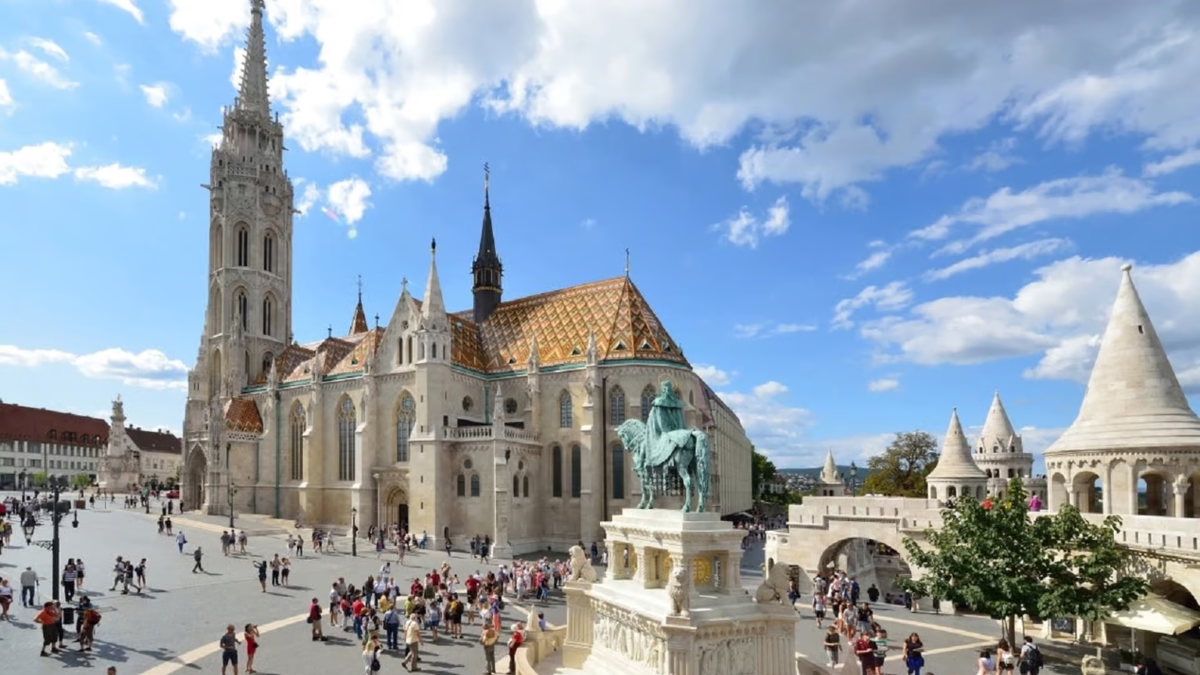
Buda Castle sits at the center of Budapest’s densest cluster of sights, and most of them are within an easy walk. On Castle Hill itself, Fisherman’s Bastion and Matthias Church are 10–15 minutes from the palace terraces, with Sándor Palace, the Hospital in the Rock, and the underground labyrinth close by. Downhill, the Chain Bridge, Várkert Bazár, and the Danube promenade lead toward Gellért Hill and its thermal baths, and a walk across the river reaches Parliament and the Shoes on the Danube memorial in Pest.
One of the best things about Buda Castle is that it’s rarely a standalone stop. Castle Hill (Várhegy) packs several of Budapest’s most photographed sights into a walkable radius, and the neighborhoods just below the hill add a second layer — a Danube bridge, a riverside garden complex, a promenade, and a second hill with its own thermal baths. Cross the river and a third cluster, anchored by the Hungarian Parliament, is only a bridge away.
This guide organizes everything near Buda Castle by walking distance, from the closest Castle Hill neighbors to the attractions across the river in Pest, with rough distances and times so you can build a realistic day rather than guessing at the map.
Distances & Walking Times at a Glance
Fisherman’s Bastion and Matthias Church are the closest neighbors, a 10- to 15-minute walk from the palace terraces. The Chain Bridge and Várkert Bazár are a similar distance downhill. Gellért Hill and the baths take a real 25- to 40-minute walk (or a short taxi/tram ride), and Parliament and the Shoes on the Danube in Pest are 25 to 30 minutes away on foot across the river.
These figures are approximate walking times at an easy pace from the Buda Castle palace terraces, and they’ll run longer if you stop for photos, deal with crowds, or take the cobbled route rather than the flattest path. Treat them as planning ranges, not guarantees, and check a map on the day for your specific starting point on the hill.
| Attraction | Approx. Distance | Walking Time | Notes |
|---|---|---|---|
| Fisherman’s Bastion | ~700 m | 10–15 min | Level to gently sloped, along Castle Hill’s lanes |
| Matthias Church | ~650 m | 10–15 min | Right beside Fisherman’s Bastion |
| Sándor Palace (exterior) | Adjacent to the palace | 1–2 min | View from outside only; not open to the public |
| Hospital in the Rock | ~500 m | 8–12 min | Entrance on Lovas út, north side of the hill |
| Labyrinth / cave entrances | ~400–600 m | 8–12 min | Separate entrances on Úri utca and Dárda utca |
| Chain Bridge / Clark Ádám tér | ~600 m downhill | 10–15 min walking, ~2 min by funicular | Funicular’s lower station |
| Várkert Bazár | ~300 m downhill | 5–8 min | Elevators/escalators down to the embankment |
| Danube promenade | ~600 m downhill | 10–15 min | Riverside path below the hill |
| Gellért Hill / Citadella | ~2 km | 30–40 min, or a short taxi/bus | A separate hill; involves a real climb |
| Rudas / Gellért Baths | ~1.5–2 km | 25–35 min | Near the base of Gellért Hill, by the river |
| Parliament (Pest) | ~1.7 km | 25–30 min, crossing the Chain Bridge | On foot or by tram across the river |
| Shoes on the Danube | ~1.6 km | 25–30 min | Pest embankment, near Parliament |
On Castle Hill: Buda Castle’s Closest Neighbors
Castle Hill’s other big sights — Fisherman’s Bastion, Matthias Church, Sándor Palace, the Hospital in the Rock, and the underground labyrinth and caves — all sit within about a 15-minute walk of Buda Castle’s palace terraces, on the same UNESCO-listed ridge.
Everything in this section shares the hill with Buda Castle, which is why so many visitors treat Castle Hill as a single half-day or full-day outing rather than a quick stop at the palace alone.
Fisherman’s Bastion
Fisherman’s Bastion (Halászbástya) is the fairy-tale, neo-Romanesque terrace of seven cone-topped towers that has become one of the most photographed spots in Budapest, framing a classic view across the Danube to Parliament. It’s roughly a 10- to 15-minute walk north of the palace, mostly level or gently sloped since you’re already up on the hill. As with Buda Castle’s own grounds, most of it is free: the lower terraces and staircases are open 24/7 at no charge, and only the upper walkway between the towers requires a small paid ticket. Our full Fisherman’s Bastion guide covers the seven towers’ history, the best viewpoints, and photo timing in detail.
Matthias Church
Matthias Church (Mátyás-templom) stands right beside Fisherman’s Bastion on Trinity Square (Szentháromság tér), instantly recognizable by its diamond-patterned Zsolnay-tile roof. It’s a working Catholic parish as well as a ticketed sight, with a frescoed interior, a small crypt and treasury, and a history that runs from medieval parish church to Ottoman-era mosque to the coronation site of the last two Habsburg kings of Hungary. See our Matthias Church guide for hours, tickets, and etiquette, since it closes to sightseers during services.
Sándor Palace (Exterior)
Sándor Palace sits right at the top of the funicular, next to the main palace, and is the official residence of the President of Hungary. It is not open to the public for general sightseeing, so the visit here is exterior only: the Neoclassical facade, the flagpole, and — on many days — a ceremonial Guard of Honor at the entrance, which is worth timing a photo around if you happen to pass while it’s on duty. Confirm any current guard-changing schedule locally rather than planning your day around it, since ceremonial timing can shift.
The Hospital in the Rock
Carved into the same limestone caves that run beneath Castle Hill, the Hospital in the Rock (Sziklakórház) is a real WWII-and-Cold-War hospital and bunker turned museum, entered from Lovas út on the hill’s north side, about 8 to 12 minutes from the palace. It’s a sobering, guided-tour-only visit with preserved medical equipment and wax figures depicting the 1944–45 siege and the Cold War years — a different, more serious experience than the bastion’s photo-friendly terraces.
The Labyrinth and Caves
Castle Hill is riddled with natural caves, connected and enlarged over centuries into cellars, shelters, and — in one section — the guided cave and cellar tour that enters from Dárda utca. A separate exhibition, the Labyrinth (Budavári Labirintus), uses another part of the same underground network via an entrance on Úri utca, though its operator and format have changed hands more than once, so it’s worth confirming its current status before building a visit around it specifically. Our guide to the Buda Castle Tunnels & Underground Labyrinth explains how the cave tour, the Labyrinth, and the Hospital in the Rock differ and how to choose between them.
Viewpoints
Beyond the named attractions, Castle Hill is dense with free viewpoints: the palace’s own Danube-facing terraces, the quieter Savoy Terrace, and the panorama from Fisherman’s Bastion each offer a different angle on the river, the Chain Bridge, and Parliament. None of these require a ticket. Our guide to the Buda Castle Grounds & Views breaks down exactly where to stand and the best light for photos.
Below Castle Hill: The Chain Bridge, Várkert Bazár & Danube Promenade
Downhill from the palace, the Chain Bridge, Várkert Bazár, and the Danube promenade are all within a 5- to 15-minute walk or a couple of minutes by funicular. Together they form the natural link between Castle Hill and the riverside attractions further south, including Gellért Hill.
The Chain Bridge
The Chain Bridge (Széchenyi Lánchíd), one of Budapest’s defining landmarks, crosses the Danube directly below Castle Hill and is the lower terminus of the funicular. It’s a 10- to 15-minute walk down from the palace terraces (or about two minutes by funicular in the other direction), and it’s the most atmospheric way to cross toward Pest on foot, especially lit up after dark. The Zero Kilometer Stone at its Buda-side end, marking the point from which all Hungarian road distances are measured, is a small, easy-to-miss detail worth a glance.
Várkert Bazár (Castle Garden Bazaar)
Várkert Bazár is a restored 19th-century garden and pavilion complex on the slope between the palace terraces and the river, about 5 to 8 minutes downhill. It functions as both a scenic, landscaped approach to Castle Hill and a pleasant stop in its own right, with elevators and escalators that make it one of the easiest step-free routes up or down — a detail covered in more depth in our accessibility guide. Some exhibitions inside its pavilions charge separately, but walking the gardens themselves is free.
The Danube Promenade
The riverside promenade running below Castle Hill, on the Buda side, is a flat, pleasant walk with the palace and Fisherman’s Bastion rising above you on one side and the river and Pest skyline on the other. It’s the natural connector if you’re walking from the Chain Bridge south toward Gellért Hill and the thermal baths, rather than climbing back up to the hill each time.
Gellért Hill, the Citadella & the Thermal Baths
Gellért Hill is a separate hill south of Castle Hill, about a 30- to 40-minute walk (or a short taxi or bus ride), topped by the Citadella fortress and the Liberty Statue with sweeping views over the whole city. At its base, near the river, sit the Rudas and Gellért thermal baths — a natural next stop after a day of walking.
Gellért Hill (Gellért-hegy) is its own climb, not an extension of Castle Hill, and it’s worth being honest about that before setting out on foot: the walk from Buda Castle is roughly 2 km and 30 to 40 minutes, much of it uphill once you reach the base of the hill itself, so budget real time and energy rather than treating it as a quick add-on. A taxi, rideshare, or public transit to the base cuts that down considerably if you’d rather save your legs for the final climb.
At the top, the Citadella — a 19th-century fortress — and the Liberty Statue (Szabadság-szobor), a monumental bronze figure visible from much of the city, anchor one of the best panoramic views in Budapest, taking in both Buda and Pest, the river, and Castle Hill itself from across the valley.
At the base of Gellért Hill, close to the river, the Rudas and Gellért thermal baths are two of Budapest’s best-known bathing complexes, drawing on the city’s natural thermal springs — the same geology responsible for the karstic caves under Castle Hill. Rudas is the older, more traditionally Ottoman-style bath, while the Gellért Baths sit inside the Art Nouveau Gellért Hotel. Both are a reasonable walk from Buda Castle (roughly 25 to 35 minutes) and make a relaxing way to end a long day of hill-walking and cobblestones.
Across the River in Pest: Parliament & the Shoes on the Danube
A walk across the Chain Bridge and along the Pest embankment reaches the Hungarian Parliament Building and the Shoes on the Danube memorial in about 25 to 30 minutes from Buda Castle. Both sit on the Danube’s Pest bank, close enough together to see in the same stop.
Crossing the river adds a genuinely different side of Budapest to a Castle Hill day. The Hungarian Parliament Building, one of the most photographed buildings in Europe, sits directly across the Danube from Castle Hill and is visible from the palace terraces and Fisherman’s Bastion long before you reach it on foot — the walk itself, across the Chain Bridge and along the embankment, takes roughly 25 to 30 minutes and is one of the best views-while-walking routes in the city.
Close to Parliament, set into the embankment itself, the Shoes on the Danube (Cipők a Duna-parton) is a quiet, sobering memorial: rows of cast-iron shoes marking where Jewish Budapest residents were shot into the river by Arrow Cross militia during WWII. It’s an easy add-on to a Parliament visit, a few minutes’ walk along the riverside, and a stop worth approaching with the same respect as the Hospital in the Rock back on Castle Hill.
A Suggested Walking Route
A route that links most of this without much backtracking might run: start at the Buda Castle terraces, walk north past Sándor Palace’s exterior to Matthias Church and Fisherman’s Bastion (10–15 minutes), then descend via Várkert Bazár or the funicular to the Chain Bridge (another 10–15 minutes). From there, either cross the bridge into Pest for Parliament and the Shoes on the Danube (25–30 minutes round trip from the bridge), or head south along the Danube promenade toward Gellért Hill and the Rudas or Gellért Baths for the afternoon. Trying to do both the Pest crossing and Gellért Hill in the same day, on top of Castle Hill itself, makes for a genuinely long day — most visitors pick one direction and save the other for a second day in Budapest.
How to Build a Castle Hill Day
A tight half-day covers Buda Castle’s grounds, Fisherman’s Bastion, and Matthias Church. A fuller day adds the Chain Bridge, Várkert Bazár, and either Gellért Hill or a Pest crossing to Parliament. Doing all of it — both Gellért Hill and Pest — comfortably in one day is ambitious given the walking and elevation involved.
For a half-day, focus on Castle Hill itself: the free palace grounds and terraces, Fisherman’s Bastion, and Matthias Church, with time for coffee or lunch on Trinity Square. This is realistic in three to four hours without rushing.
For a full day, add the walk down to the Chain Bridge and Várkert Bazár, then pick one further destination — either Gellért Hill and a thermal bath, or a crossing into Pest for Parliament and the Shoes on the Danube. Both directions involve real distance and, in Gellért Hill’s case, a genuine climb, so choosing one keeps the day comfortable rather than exhausting.
For those with more than one day in Budapest, splitting Castle Hill from the Gellért Hill and Pest sides across two separate outings is the least tiring approach, and it leaves room to linger at each rather than treating everything as a checklist. Whichever pace you choose, our guide on how long to spend at Buda Castle has more detail on timing the castle portion itself, and if you’d rather have a guide narrate the Castle Hill section, the Buda Castle Hill Tour covers the palace, Fisherman’s Bastion, and Matthias Church together.
Frequently Asked Questions
What’s within walking distance of Buda Castle?
On Castle Hill itself: Fisherman’s Bastion, Matthias Church, Sándor Palace’s exterior, the Hospital in the Rock, and the underground labyrinth and caves, all within about 15 minutes. Downhill, the Chain Bridge, Várkert Bazár, and the Danube promenade lead toward Gellért Hill and, across the river, Parliament.
How far is Fisherman’s Bastion from Buda Castle?
It’s roughly 700 meters, about a 10- to 15-minute walk along mostly level or gently sloped lanes on Castle Hill. Matthias Church sits directly beside it, so most visitors see both in the same stop.
Can I walk from Buda Castle to the Chain Bridge?
Yes. It’s about 600 meters downhill, roughly 10 to 15 minutes on foot, or around two minutes by funicular if you’d rather skip the walk down. The funicular’s lower station sits right at the Buda-side end of the bridge.
Is Gellért Hill walkable from Buda Castle?
Yes, but it’s a real walk of about 2 km and 30 to 40 minutes, including a genuine climb once you reach the base of the hill. A taxi, rideshare, or public transit to the base is worth considering if you’d rather save your energy for the climb itself.
Can I see Parliament from Buda Castle without crossing the river?
You can see it from a distance — the palace terraces and Fisherman’s Bastion both offer clear views across the Danube to Parliament. To visit it up close, plan a walk of roughly 25 to 30 minutes across the Chain Bridge and along the Pest embankment.
What’s the difference between Fisherman’s Bastion and Matthias Church?
Fisherman’s Bastion is a largely free, 19th-century viewing terrace with seven symbolic towers, best known for its Danube panorama. Matthias Church, right beside it, is a ticketed, working parish church known for its Zsolnay-tile roof and coronation history. They’re separate attractions with separate tickets, standing side by side.
Can I visit Sándor Palace?
No, not for general sightseeing — it’s the working residence of the President of Hungary and isn’t open to the public. Most visitors see it from outside only, on the way between the funicular and the palace.
Is the Hospital in the Rock near Buda Castle?
Yes, it’s on the same hill, entered from Lovas út on the north side, about 8 to 12 minutes from the palace terraces. It’s a separate, guided-tour-only attraction from the museums inside Buda Castle itself.
How long does it take to see Castle Hill and its neighbors in one day?
A focused half-day covers Buda Castle, Fisherman’s Bastion, and Matthias Church. A fuller day can add the Chain Bridge and either Gellért Hill or a crossing to Parliament, but combining both of those extra directions in a single day makes for a long, tiring itinerary.
Are the thermal baths near Buda Castle within walking distance?
Rudas and Gellért Baths, at the base of Gellért Hill, are roughly 25 to 35 minutes on foot from Buda Castle, mostly flat along the riverside promenade before the final stretch. It’s a reasonable walk, though a taxi or public transit is a fine option after a full day of sightseeing.
