

Buda Castle Audio Guide Review: Is Self-Guided Worth It?
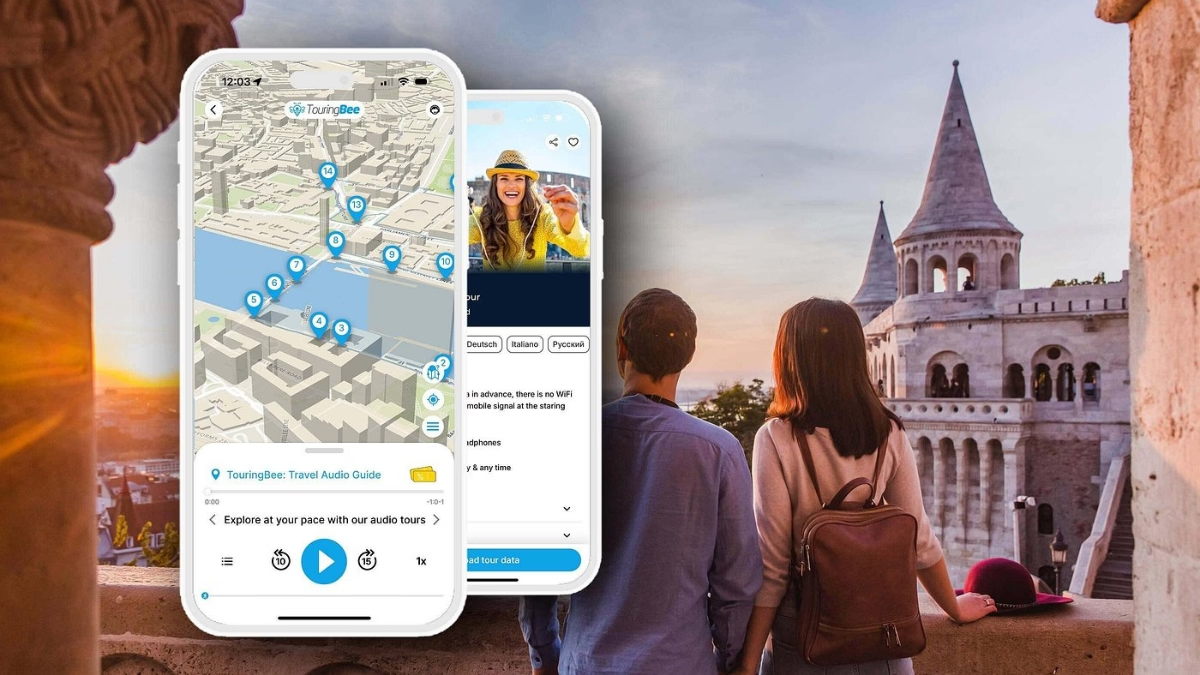
Self-guided audio tours of Buda Castle are smartphone apps or downloadable GPS walking tours that talk you through the free grounds, history, and viewpoints at your own pace, usually for a small one-time fee or free with an app download. They’re cheap, flexible, and work well since the outdoor parts of Castle Hill cost nothing to visit anyway, but you lose the live Q&A, local color, and route-planning a human guide provides. They’re worth it for independent, budget-conscious, or flexible-schedule travelers; a live guided tour suits those who want interaction and zero planning.
Buda Castle is one of the easiest places in Budapest to explore on your own, mostly because the best of it — the courtyards, terraces, and Danube-facing viewpoints — is free, outdoor public space with no ticket gate to pass through. That makes it a natural fit for self-guided exploring: you can wander at your own pace with a phone in hand instead of paying for and scheduling a live tour. The question is whether an audio-guide app actually adds enough over just walking around with a map, and how it stacks up against booking a real guide.
This review covers what self-guided audio options for Buda Castle actually are, what they cover (and don’t), the honest pros and cons versus a live guided tour, typical cost, how to use one offline, and who each approach suits best.
What “Self-Guided” Actually Means Here
At Buda Castle, “self-guided” mostly means a smartphone audio-guide app or a downloadable GPS walking tour that narrates the grounds, history, and viewpoints while you walk — as opposed to a live human guide walking with you. It’s a different thing from the in-house audio guides some museums rent at their own ticket desks.
There are really three separate ways to get commentary at Buda Castle, and it’s easy to conflate them. First, there are third-party smartphone audio-tour apps and GPS-triggered walking tours — download one before you go, put in earbuds, and it plays narration as you approach each stop on Castle Hill, whether that’s the Matthias Fountain, a terrace overlook, or a historic gateway. Second, there’s a live guided tour, where an actual person walks the same ground with a small group and answers questions in real time. Third, and distinct from both, the museums inside the palace — the Hungarian National Gallery and the Budapest History Museum — run their own in-house audio guides for visitors touring the collections, usually a handset or an app tied to that museum’s exhibit numbering. A self-guided castle-grounds app won’t get you commentary inside those museums, and a museum’s in-house audio guide won’t cover the outdoor grounds beyond its own building. Keep the two separate when you’re planning: this review is about the outdoor, grounds-and-history self-guided option, not what’s rented at a museum front desk.
What Self-Guided Audio Options Cover
Self-guided audio tours of Buda Castle typically cover the free outdoor grounds — the courtyards, gates, fountains, and viewpoints — along with the history of the site and pointers to the best photo spots. They do not include entry to the ticketed museums or Saint Stephen’s Hall, which are separate, paid, and have their own access rules.
Because they’re built around the parts of Castle Hill you can walk into without a ticket, self-guided audio tours are naturally aligned with the free grounds. Expect narration on the story of the site — the medieval origins under Béla IV, the Renaissance court of King Matthias Corvinus, the 1686 recapture from the Ottomans, the near-total destruction in the 1944–45 siege of Budapest, and the postwar rebuilding — layered over stops at the courtyards, the ornamental gateways, the Matthias Fountain, and the terraces looking over the Danube toward Parliament and the Chain Bridge. Some routes extend beyond the palace itself to cover Castle Hill’s other free landmarks, like the streets of the old town or the approach to Fisherman’s Bastion.
What a self-guided grounds tour won’t do is get you inside the Hungarian National Gallery, the Budapest History Museum, or Saint Stephen’s Hall — those require their own tickets, and Saint Stephen’s Hall is guided-tour-only regardless. If art or the palace’s excavated medieval interior is the point of your visit, budget separately for admission. A self-guided app is a companion for the outdoor experience, not a substitute for museum entry.
Self-Guided vs a Live Guided Tour: Honest Pros and Cons
Self-guided audio tours are cheaper, more flexible, and let you set your own pace, but you lose live Q&A, local storytelling and improvisation, and someone to handle the route and timing for you. A live guided tour costs more and runs on a fixed schedule, but gives you a real conversation and a guide who reads the group and adjusts.
Self-guided audio tour — pros:
- Cheap: often a small one-time app or route fee, and some options are free.
- Flexible timing: start, pause, or stop whenever you want, with no meeting point or group to keep up with.
- Your own pace: linger at a viewpoint for photos or skip a stop that doesn’t interest you.
- No language barrier if the app offers your language, since you’re reading or listening on your own device.
- Works well with spontaneous plans, since there’s nothing to book in advance.
Self-guided audio tour — cons:
- No live Q&A: if something isn’t covered or you want more detail, there’s no one to ask.
- Less personality: pre-recorded narration can’t read the group, react to weather, or adapt on the fly the way a guide can.
- GPS and audio glitches happen, especially in courtyards with tall walls, and a dead phone battery ends the tour.
- You do the navigating; even with GPS prompts, it’s still on you to find each stop.
- Doesn’t replace a ticketed museum visit or a guided-only experience like Saint Stephen’s Hall.
Live guided tour — pros:
- A real person to ask questions, who can go deeper on whatever the group finds interesting.
- Local color, stories, and context that a script doesn’t always capture.
- Someone else handles the route, pacing, and logistics.
- Often includes access a self-guided app can’t offer, such as Saint Stephen’s Hall or the underground Cave Tour.
Live guided tour — cons:
- Costs more than a self-guided app, and prices shift with demand and season.
- Fixed start time and group pace, so you can’t easily linger or skip ahead.
- Booking ahead is generally required, especially for popular time slots in summer.
Neither approach is objectively better — it comes down to whether you value flexibility and cost over live interaction and someone else doing the planning. Our Buda Castle Small Group Walking Tour and Buda Castle Walking Tour with a Historian reviews cover what the live-guide side of that trade-off looks like in practice.
Cost: What You’ll Actually Pay
Self-guided audio-tour apps for Buda Castle typically cost nothing to download, with either a small one-time fee for the specific route (often a few euros) or a free tour supported by in-app extras. That’s markedly less than a live guided tour, which is priced per person and usually runs from the mid-teens to the €30s in euros depending on the operator and what’s included.
Because the palace grounds themselves are free, the only cost with a self-guided option is the app or route itself, and pricing across the category tends to be modest — commonly a small one-time purchase per route, occasionally free, rather than a recurring subscription. That’s the main financial appeal: for the price of a coffee (or nothing at all), you get narrated commentary covering the same free space a live tour walks through for a per-person fee that’s typically several times higher. Exact prices vary by provider and change over time, so check the current listing on the app store or booking platform before assuming a figure. For a full breakdown of what the paid, ticketed side of Buda Castle costs — the museums and Saint Stephen’s Hall — see Buda Castle Ticket Prices.
How to Use a Self-Guided Audio Tour, Including Offline
Download the app and the specific Buda Castle route before you arrive, ideally over Wi-Fi, since most self-guided tours support offline playback once the content is downloaded to your phone. On the hill, GPS and data coverage can be patchy near thick stone walls, so having the route stored locally rather than streamed is the safer approach.
The practical steps are the same across most audio-guide apps: install the app, find the Buda Castle (or Castle Hill) route, and download the audio and map content in advance rather than relying on streaming it live. Do this before you leave your hotel or Airbnb, ideally on Wi-Fi, since mobile data on Castle Hill can be inconsistent between the dense stone buildings and courtyards, and roaming data isn’t something every visitor wants to burn through anyway. Bring headphones or earbuds, keep your phone charged (a portable battery pack is a good idea for a half-day out), and check that the app’s GPS-triggered playback actually works offline — some apps trigger narration automatically as you approach a stop using GPS alone, which typically still works without a live data connection once the content is downloaded, while others need you to tap each stop manually if GPS drifts. If in doubt, test the download and offline playback at your accommodation before you climb the hill, so you’re not troubleshooting an app on-site.
Who Self-Guided Suits Best (and Who Should Book a Guide)
Self-guided audio tours suit independent travelers, budget-conscious visitors, early risers or night owls who want to explore outside museum hours, and anyone who prefers to set their own pace. A live guided tour suits first-time visitors who want context without research, groups who enjoy asking questions, and anyone short on time who wants someone else to plan the route.
A self-guided app is a strong fit if you’re traveling solo or as a couple, keeping costs down, or want to explore Castle Hill at an odd hour — since the grounds are open 24/7, you can walk the terraces at sunrise or after dark with narration in your ears when no live tour would be running anyway. It also suits travelers who’ve already done some reading and mainly want prompts and context rather than a full narrated history, and anyone who prefers not to commit to a fixed start time.
A live guided tour is the better call if you’d rather ask questions than read a screen, you’re visiting with people of different interests who benefit from a guide adjusting on the fly, or you want the palace’s history explained by someone with local knowledge rather than a script. It’s also the only route to certain experiences — Saint Stephen’s Hall has no walk-in or self-guided option, and the underground cave network is guided-only for safety and access reasons.
Pairing the Free Grounds with a Self-Guided Walk
Because the courtyards, terraces, and viewpoints at Buda Castle are free and open 24/7, they’re the ideal match for a self-guided audio tour — there’s no ticket queue, no time slot, and no reason not to explore at your own pace with narration running.
This is really the strongest argument for going self-guided at Buda Castle specifically: unlike a ticketed museum or a guided-only interior, the grounds have no gate, no opening-hours restriction beyond common sense, and no crowd bottleneck at an entrance. That means a self-guided walk can start whenever you like, run as long or as short as you want, and cost nothing beyond the app itself. Pair it with an early-morning or evening visit for quieter courtyards and better light, and add a museum ticket separately if you also want to go inside. See our guide to Buda Castle Grounds & Views for where the best outdoor photo spots are, and What’s Inside Buda Castle for a full map of the free versus ticketed sides of the hill.
Verdict: Is the Self-Guided Option Worth It?
For most independent travelers who mainly want to understand what they’re looking at while walking the free grounds, a self-guided audio tour is worth it — it’s inexpensive, works on your own schedule, and matches the fact that the best of Buda Castle costs nothing to access anyway. It’s a weaker fit if what you actually want is a conversation with a knowledgeable local, access to guided-only experiences like Saint Stephen’s Hall or the caves, or someone else to handle timing and route on a tight schedule — in those cases, a live guided tour is the better spend. Many visitors reasonably do both: a self-guided walk of the grounds on their own time, plus one live tour or museum ticket for whichever interior most interests them.
Frequently Asked Questions
Is there an official Buda Castle audio guide?
There’s no single official third-party audio-guide app tied to Buda Castle as a whole; instead, various self-guided smartphone apps and GPS walking-tour platforms cover the grounds, and each museum inside the palace runs its own in-house audio guide for its exhibits. Check the current app listings before your trip, since availability changes.
Do self-guided audio tours include museum entry?
No. Self-guided audio tours of Buda Castle cover the free outdoor grounds, history, and viewpoints, not entry to the Hungarian National Gallery, the Budapest History Museum, or Saint Stephen’s Hall. Those require separate tickets, priced individually by each institution.
Can I use a self-guided audio tour without internet access?
Yes, most self-guided audio apps let you download the route and audio in advance for offline playback, which is recommended since mobile data can be patchy in Castle Hill’s stone courtyards. Download everything before you leave your accommodation, ideally over Wi-Fi.
How much does a Buda Castle audio guide cost?
Third-party self-guided apps for the grounds are generally inexpensive, often a small one-time fee per route or free, though exact pricing varies by provider and changes over time. That’s typically much less than a live guided tour, which is priced per person and runs higher.
Is a self-guided tour better than a live guided tour?
Neither is universally better — it depends on what you want. Self-guided options are cheaper and more flexible; a live guide offers real conversation, local knowledge, and access to guided-only experiences like Saint Stephen’s Hall or the caves.
Do I need to book a self-guided audio tour in advance?
Not in the way you’d book a live tour with a fixed time slot. You can download most self-guided apps and routes right up until you arrive, though downloading before you leave your accommodation avoids relying on spotty mobile data on the hill.
What does a self-guided audio tour actually cover at Buda Castle?
Typically the free courtyards, gates, fountains, and viewpoints, along with the site’s history from its medieval origins through the 1944–45 siege and postwar rebuilding. It won’t cover what’s inside the ticketed museums, which have their own separate in-house audio guides.
Can I do a self-guided audio tour at night?
Yes. Since the Buda Castle grounds are open 24/7, a self-guided app works just as well after dark, when the palace and city are floodlit and a live guided tour likely isn’t running. Just make sure your route download and offline playback are set up in advance.
Is it worth paying for a self-guided app instead of just walking around with a map?
For many visitors, yes — a low-cost audio route adds historical context and points you to the better viewpoints and photo spots you might otherwise walk past. If you’re comfortable researching the site yourself beforehand, a free map and this guide may be enough on their own.
What’s the alternative if I want a live guide instead?
Several guided options cover Buda Castle, including small-group walking tours and tours led by a historian, plus guided-only experiences like Saint Stephen’s Hall and the underground caves. See the Related Guides below for full reviews of the live-guide alternatives.
